The Anatomy of a Resilient System: Building for the “Low-Spoon” Days


We’ve all been there. You sit down with a fresh cup of coffee and a master plan that could rival a military operation. You’ve got the categories, the color-coded blocks, and the ambition to build an empire by sunset.
But then, life happens. Or rather, the “energy tax” hits.
Maybe it’s a high-stress week, a string of late nights, or just one of those days where the mental “spoons” you started with have seemingly vanished by noon. Suddenly, that beautiful system you built feels like a judge, pointing a finger at everything you aren’t getting done.
That’s where the guilt creeps in. We start feeling like imposters in our own lives because we aren’t hitting the “ceiling” every single day.
The Trap of the “Perfect Version”
The biggest mistake we make when organizing our lives is building a system for the “perfect version” of ourselves—the one with boundless energy and zero distractions. But a system isn’t actually “better” if it only works when you’re at 100%.
A truly resilient system—one that actually moves the needle—is built for the person you are when you’re tired, foggy, and just trying to keep the wheels turning.
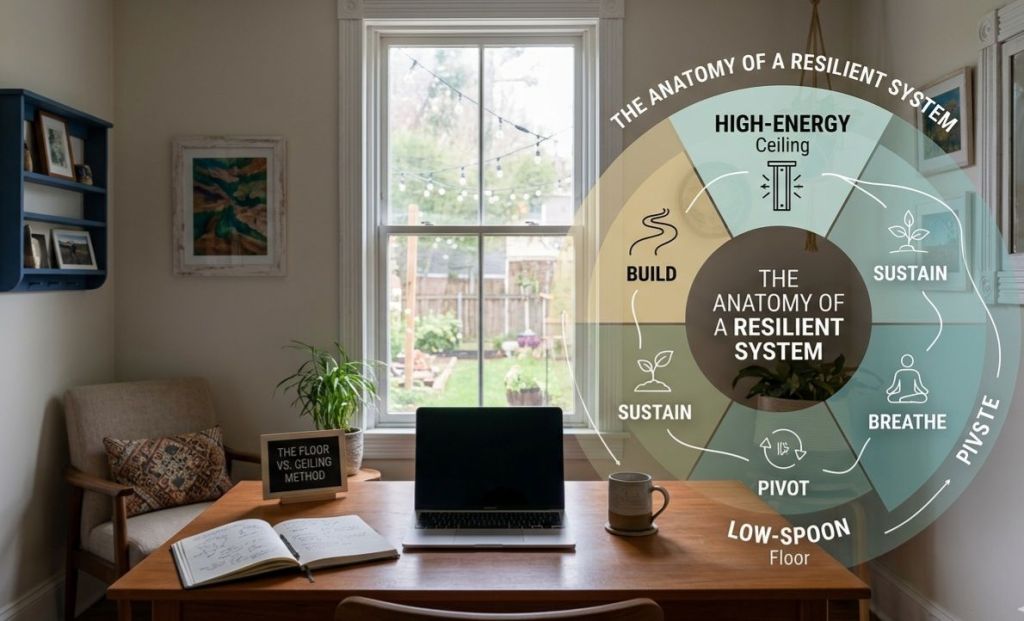
The Floor vs. The Ceiling
Think of your goals in two layers: The Ceiling and The Floor.
The Ceiling is your high-energy mode. This is where the heavy lifting happens—the deep creative work, the technical problem-solving, the “building” phase.
The Floor is your baseline. It’s the absolute bare minimum required to keep the momentum alive without burning out.
On low-energy days, your only job is to stay on the floor. If you can’t write the whole chapter, write one sentence. If you can’t reorganize the entire inventory, just clear one shelf. Success isn’t hitting the ceiling every day; it’s refusing to drop below the floor.
Choosing Your Focus (When You Only Have One Spoon Left)
When energy is low, we tend to panic and try to do a little bit of everything, which usually ends in doing nothing well. Instead, ask yourself: “Which one thing will make me feel the most ‘at peace’ tomorrow morning?”
Sometimes the most productive thing you can do is “Maintenance” rather than “Growth.” Pushing yourself to “build” when your tank is empty is like trying to drive a car on fumes—you’ll eventually stall out, and the recovery time will be twice as long.
Forgiving the “Invisible Work”
If you’re in a phase of life where you’re researching, planning, or laying foundations, it can feel like you have nothing to show for your effort. This is where the imposter syndrome thrives. It whispers that if there’s no finished product, the work didn’t happen.
Don’t listen.
The invisible work—the thinking, the organizing, the learning—is the infrastructure. You can’t hang the drywall until the frame is up. If today was a day for framing and not for decorating, that is still a win.
Building to Breathe
As you look at your week, ask yourself: Is my system a cage, or is it a support beam?
A better system doesn’t demand more of you; it manages what you have. It gives you permission to pivot when the spoons are low and the grace to ignore the guilt when you need to rest.
Build a system that breathes. Because you aren’t a machine, and your value isn’t measured by how many boxes you checked when you were running on empty.

Mom Burnout Doesn’t Always Look Like Breaking Down


When people talk about burnout, they usually picture someone falling apart.

Crying.
Snapping.
Completely overwhelmed and unable to keep going.

And sometimes it does look like that.

But sometimes it doesn’t.

Sometimes burnout is quiet.

It looks like getting up every day and doing exactly what needs to be done, but feeling nothing while you do it.
It looks like checking the boxes, answering the calls, making the meals, showing up for everyone… and still feeling like you are not really there.

Not sad enough to fall apart.
Not okay enough to feel at peace.

Just somewhere in the middle.

Stuck.

I think that version of burnout is harder to recognize, because from the outside, everything looks fine.

You are still functioning.
The house is still running.
The kids are still cared for.
Life is still moving forward.

But inside, something feels off.

You are tired in a way that sleep does not fix.
You are overwhelmed in a way that is hard to explain.
You are needed constantly, and somehow still feel invisible.

And then comes the guilt.

Because how do you admit you are burned out when you are still doing everything you are supposed to do?

How do you say you are struggling when nothing is technically falling apart?

So you don’t.

You push it down.
You tell yourself other people have it harder.
You remind yourself to be grateful.

And you keep going.

That is what a lot of mom burnout actually looks like.

It is not always a breaking point.

Sometimes it is a slow fading.

A quiet losing of yourself in the middle of taking care of everyone else.

A life that starts to feel more like responsibility than something you are living.

And the hardest part is, you can stay there for a long time.

Because nothing forces you to stop.

There is no clear moment where everything crashes and demands your attention.

There is just that quiet voice in the back of your mind that says, something is not right.

If you are in that place, I want you to hear this.

You do not have to fall apart for your burnout to be real.

You do not have to earn rest by reaching a breaking point.

You are allowed to acknowledge that you are tired.
You are allowed to admit that something feels off.
You are allowed to need more than just getting through the day.

Not every season is meant to feel full and meaningful and balanced.

Some seasons are heavy.

But you are still in there somewhere.

Even if you feel a little disconnected.
Even if you are just going through the motions right now.

This is not the end of you.

It is a signal.

A quiet one, maybe.
But an important one.

And maybe the next step is not fixing everything all at once.

Maybe it is just noticing.

Maybe it is just being honest with yourself.

Maybe it is just giving yourself permission to say, this is harder than I thought it would be.

That matters.

More than you think.

A is for Addiction

Addiction.


Just sit with that word for a moment.
It carries weight. It sounds heavy. Shame-filled. Final. I can’t think of many positive things we associate with it.
I personally smoke cigarettes (working toward quitting), and I am absolutely a caffeine addict — and probably sugar too. But beyond my own habits, I have loved addicts. Not just romantically. Friends. Family. People I would go to the ends of the earth for.


So let’s ask the question plainly:
Is addiction a disease? A condition to be treated? Something recovery is possible from?
Yeah. Yes. It is.


What Is Addiction?
The American Society of Addiction Medicine defines addiction as:
A treatable, chronic medical disease involving complex interactions among brain circuits, genetics, the environment, and an individual’s life experiences. People with addiction use substances or engage in behaviors that become compulsive and often continue despite harmful consequences.


The National Institute on Drug Abuse explains it similarly — addiction is a chronic, relapsing disorder characterized by compulsive drug seeking and use despite negative consequences.
Chronic.
Medical.
Treatable.


Those words matter.


And here’s something else that matters:


In the United States, about 1 in 6 people struggle with a substance use disorder each year.
Millions more struggle with nicotine dependence.
Caffeine dependence is widely recognized.
Studies show that highly processed foods can trigger brain reward systems in ways similar to addictive substances.
This isn’t rare. This isn’t “those people.” This is us. Our neighbors. Our families.


We Joke About It… But Should We?
People casually say, “I’m a coffee addict.”
Or “I’m addicted to Diet Coke.”
Or “Don’t talk to me before my sugar.”
But do we understand the weight of that word?


Yes — you really can be addicted to sugar, caffeine, nicotine, and highly processed foods. That doesn’t make you weak. It makes you human with a brain wired for reward.
Our brains are designed to remember what feels good and to repeat it. Dopamine — the “feel good” neurotransmitter — reinforces behaviors that provide pleasure or relief. Over time, repetition becomes reliance. Reliance becomes dependence.
And dependence, when disrupted, becomes withdrawal.


The Logan Story
Let me tell you a story.
Logan was 10. His mom wasn’t much of a cook, so meals were mostly pre-packaged, fast food, convenient — and let me say clearly: fed is fed. No judgment. Survival comes first.
But when summer came, Logan went to stay with Dad and stepmom. They cooked fresh food. Fruits. Vegetables. Homemade meals. Grilled burgers and hot dogs.
Within days, Logan had what looked like the flu. Headaches. Fatigue. Irritability. Just not himself.
His big sister picked him up, took him to the movies and — yes — McDonald’s.
Miraculous recovery.
Until a week later, when the “flu” returned.
He wasn’t sick. He was withdrawing.
His body had become accustomed to high levels of sugar, sodium, and processed additives. When they disappeared, his system reacted.
Dad refused to reintroduce the fast food. They let his body recalibrate. It was uncomfortable. It was eye-opening. And it was very real.
Logan didn’t know he was dependent.
But his body did.


It’s All the Same Brain
Opioids.
Nicotine.
Methamphetamine.
Alcohol.
Sugar.
Caffeine.


Different substances. Same reward circuitry.
When we remove what the brain has grown used to, the body protests.


Withdrawal can look like:
Headaches
Fatigue
Anxiety
Irritability
Nausea
Depression
Physical pain


Some withdrawals are uncomfortable. Some are dangerous. Some are life-threatening.
But the mechanism? The brain wanting what it has been trained to expect.


So Where Do We Start?


We start by naming it.


Without shame.


We stop whispering about addiction like it’s a moral failure. We stop labeling people as “weak” or “lacking willpower.”
We start asking:
What pain is this numbing?
What pattern is this reinforcing?
What support is missing?
Addiction thrives in isolation. Recovery thrives in connection.
Somewhere, there has to be a conscious decision to become mindful of what we are putting into our bodies — and why.


Not with judgment.
With curiosity.


My Truth
I am a caffeine addict.
I am nicotine dependent.
I am working on both.
And I have loved addicts.


Deeply.


We need to help one another make better choices instead of judging someone’s struggle. Because it could be you. It could be me. It could be someone you love.
Addiction is not a character flaw.


It is a condition.
It is treatable.
Recovery is possible.


And compassion? That should be non-negotiable

Recalibrating Gratitude


I sometimes catch myself being ungrateful.
Not in a loud, stomping-my-feet kind of way. Not in a way that would be obvious to anyone watching. But in the quiet way where I start overlooking what’s good and fixating only on what’s wrong.
The past few months have been particularly rough — financially, emotionally, physically. I still don’t have real answers about the left flank pain, though it has improved, and for that I am thankful. The heart issues? They seem to have been a fluke… or maybe a warning shot across the bow. Either way, my heart is strong, my blood pressure has normalized, and that is no small gift.
Emotionally and physically, though? It’s felt like one of those rickety carnival rides — the kind that jerks you around without warning. Up, down, sideways, spinning just fast enough to make you question your equilibrium.
And somewhere in the middle of all that, I caught myself.
Not focusing on solutions. Not leaning into my usual “everything is figure-outable” mantra. Not scanning for silver linings or mapping out next steps.
I was wallowing.
And honestly? That’s not like me at all.
I’m the one who finds the bright side. I’m the one who reframes. I’m the one who says, “Okay, this is hard — now what are we going to do about it?”
But even the strong ones get tired. Even the optimistic ones have days where the weight feels heavier than usual.
So I did what I know to do when I feel myself drifting off course.
I recalibrated.
I carved out a little time each day to be alone. To reflect. To sit with my life and my circumstances without judgment. And somewhere in that quiet, I found something steady again.
Gratitude.
Not the fluffy, hashtag kind. The grounded kind. The kind that says: I am still here.
I am still able to spend time with my mostly grown kids.
I get to hear my sweet Aubree call me “Grand-ma-ma!”
I get to feel Charlotte slip her little hand into mine and lean in for a forehead kiss.
That is not small. That is everything.
I am fortunate. I am blessed. Even on the bad days. Even when the money feels tight. Even when my body feels unpredictable. Even when I have a moment (or two) of wallowing.
Gratitude doesn’t mean pretending things aren’t hard. It means refusing to let the hard things be the only things I see.
Perspective, y’all.
If you are weary, you are not alone. If you’ve been riding your own version of a bad carnival ride, I see you. But take a moment. Look around. Find one thing — just one — that anchors you back to what’s still good.
Recalibrate.
Because bitterness is heavy. Despair is suffocating. But gratitude? Gratitude steadies the ride.
We’ve got this.
Love and light, folks.

Becoming and Unbecoming

2026 has already been a doozy.
We welcomed January with a whole host of breaks—some expected, some not. Now we’re stepping into February, and the old groundhog has seen his shadow. Six more weeks of winter, and honestly? I’m not mad about it.
I prefer cooler temperatures. Always have. But the darkness—sometimes that gets to me. Not in a seasonal depression kind of way, more like a please give me a little more daylight so I can get things done kind of way. Still, this in-between season matters. Transition always does.
Maybe that’s why this time feels so significant—because I am transitioning too.
I’m becoming a better version of myself. A more complete self. One who is no longer trying to mask big feelings or tuck disappointments neatly out of sight for the comfort of others. I am becoming more. And if I’m too loud, too much, too intense for some people—as Elyse Myers so perfectly put it—“Go find less.”
I will happily apologize for past wrongs, for mistakes I’ve made, for moments where I fell short. But I will not apologize for being myself. If that means some people fall away, I will let them. I’ll grieve a little—because loss is still loss—but I also understand now that not everyone is meant to go where I’m headed.
This season is about becoming and unbecoming.
Letting go of what no longer fits.
Shedding versions of myself that were built for survival, not peace.
I will always fiercely defend my children and my chosen family. That part of me is immovable. But I am no longer clinging to blood ties simply because they exist. Those ties have been complicated—heavy—and loyalty owed solely to blood has caused me deep harm. I’m untangling that now. I’m lowering my expectations of people who have shown me, repeatedly, who they are.
And here’s the quiet power in that:
What I’m building next—what’s coming for me—cannot be touched or taken. It will be mine. And it will become a legacy for the family I created, not the one I was born into.
Winter can linger a little longer.
So can this becoming.
I’m not rushing it.