
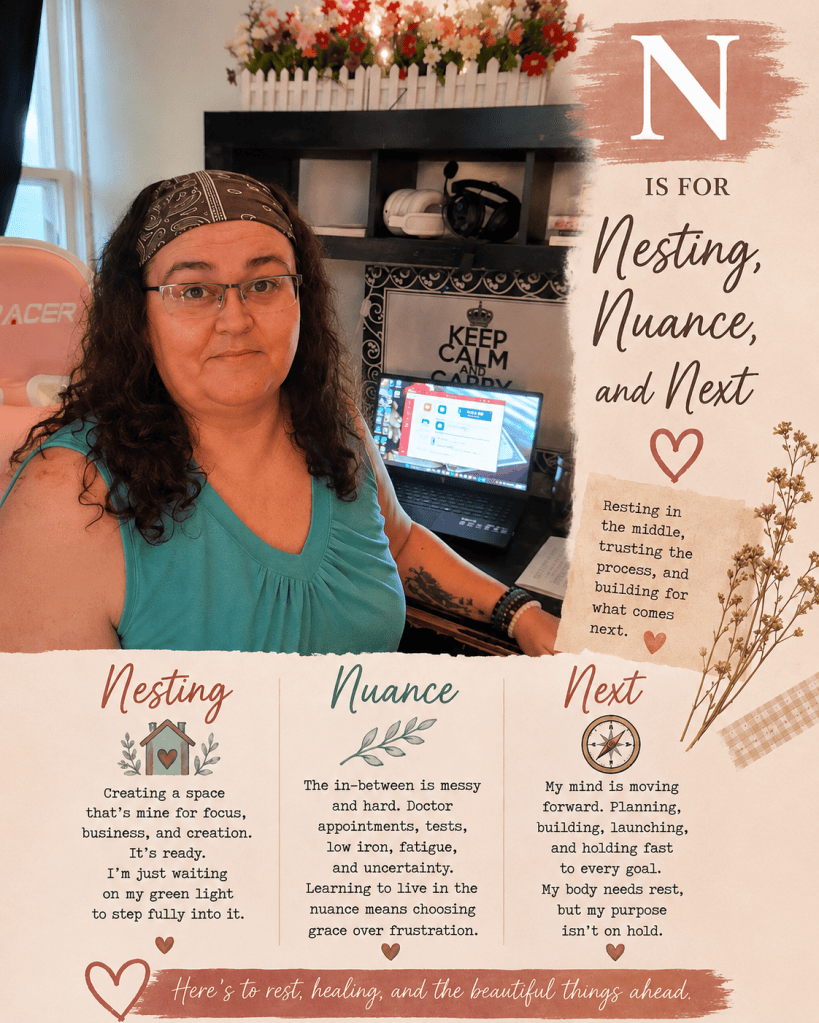
The “Heart-Work” and the “Hard-Work”: Finding My Alignment


There is a specific kind of magic that happens when “heart-work” and “hard-work” finally begin to align. For the longest time, it felt like I was operating in a valley—navigating the shadows of uncertainty, managing personal hurdles, and wondering when the pieces would start to fit together. But lately, the view has changed. I’m no longer looking at the climb; I’m looking at the moon.
Building from the Ground Up
Building something brand new requires a unique brand of “brain power.” It’s about more than just having an idea; it’s about the grit required to utilize modern tools and technology to bring a vision to life. Whether it’s developing a recipe app to streamline the heart of the home or a recycling app to help protect our planet, these projects represent the fusion of logic and passion.
My creative world has expanded into every corner of storytelling:
The Novel: Deep, immersive world-building.
The Children’s Book: Seeing the world through a lens of wonder.
Short Stories: Capturing those fleeting moments of human connection.
The Master Catalog: Baring my soul through songwriting, turning raw emotion into lyrics and melodies that I hope will eventually find their way into the world.
The Purpose Behind the Hustle
While the creative projects feed my soul, there is a grounded, protective side to this journey. Working in insurance has become a vital part of my mission. It isn’t just about policies; it’s about the people we do all of this for. It is the safety net that protects our families and our dreams, ensuring that the hard work we put in today is preserved for tomorrow.
Tools for the Ascent
Coming out of that valley required more than just luck. It took intentionality. I’ve leaned heavily into the practices that keep my mental health steady and my focus sharp:
Gratitude Journals: Finding the “wins” even on the heavy days.
Manifestation: Being unapologetic about desiring a better life and a bigger future.
Daily Goals: Smashing those small milestones that lead to massive shifts.
Nowhere to Go But Up
Just a few months ago, things felt heavy. Today, the momentum is real. My health is back in my corner, my mind is clear, and the “alignment” everyone talks about is finally starting to feel like a reality.
When you decide to shoot for the moon, you realize that the hard lessons weren’t there to stop you—they were there to prepare you for the altitude. Here’s to the heart-work, the hard-work, and everything that happens when you finally decide to go up.

Speaking from Experience

Life is Too Short for “Later”

I was looking back at a post I wrote during one of the hardest pivots of my life – the end of my marriage. At the time, I realized I couldn’t keep distracting myself with projects. I had to face the “down and dirty” reality so that my children and I could move forward.
Looking back, that season wasn’t just about ending a marriage; it was about beginning a life where I took control of my own security.
The Archive :

I am divorcing my disabled husband. It’s not what you think, the difficulties were there for years and we refused to face them. In order to move forward for myself and my children I did have to face them. I had to be ok both physically and emotionally. No more throwing myself into a project or spending hours away from the issues. 

So I sat down with my husband and we had a very difficult discussion. It took time for it all to sink in with him but we agree for the most part. Our marriage is over, it has been for a few years. We were making one another miserable and we had tried counseling, techniques, but the reality was: it was over. Without hashing out the down and dirty we are both dealing with it all in our own way. The kids are adjusting. I hope he finds a way to heal himself and be a good dad. I hope my children will one day understand that I never once made this decision lightly. It took me years to gather the courage to speak the words “I want a divorce”

Now we deal with making arrangemnets and  adjustments for different things. Ex and oldest daughter are living in a different state. Oldest son is living with his new wife as of March. I have DD2 and DD3 as well as Baby boy at home with me and my new man. (That is a tale for another day) and we are doing well. 

Love and light folks!! Life is just too darn short! 


The 2026 Pivot :
When I say “Life is too darn short,” I mean it. But I also know that when life changes—when we divorce, move states, or merge families with a “new man”—our protection needs to change with us.
When I went through my divorce, I had to learn the hard way about making arrangements, updating bank accounts, and checking beneficiaries. I became an agent because I don’t want anyone else to navigate those “adjustments” alone or unprotected.
Are Your “Arrangements” Up to Date?
If you’ve gone through a divorce, a move, or a family change, your old insurance policy might still be protecting a reality that no longer exists. Let’s make sure your children are the ones who are actually set up for the future.


Julie Kilcrease
Licensed Life Insurance Agent | Texas
NPN: 21375920
Helping you protect the life you’ve worked so hard to build.

The Second Half of the Season: Finding Our Bloom


There is a specific kind of quiet that happens right before spring really takes hold. In the songwriting world, we talk a lot about “the hook”—that moment where everything clicks and the story finds its rhythm. Life has those moments, too, but they often come after a season of being dormant.


As we move into late April, I’ve been thinking a lot about what it means to enter the “second half” of a journey. Whether it’s a creative project, a career shift, or just a new chapter in a family’s story, the transition isn’t always loud and flashy. Sometimes, it’s just a steady, quiet reclaiming of who you are meant to be.


Resilience in the Roots
In this part of the country, the earth is tough. It takes a certain kind of strength for a seed to push through that heavy soil. I think we’re a lot like that. We carry the weight of our past seasons—the winters that felt a little too long or the storms that shook our fences—but we still find a way to reach for the light.


Defining Your Narrative
One of the most powerful things we can do is decide how our story is told. For me, that’s happening through music and words, finding the melody in the transitions. But you don’t have to be a songwriter to rewrite your rhythm.
Listen to the change: What is the “new song” in your life right now?


Honor the growth: Even if you aren’t exactly where you planned to be, look at how far the roots have gone down.
Accept the timing: Some things bloom early; some take their time. Both are beautiful.
Looking Ahead


As the days get longer and the “Mother-Sense” kicks in, I’m leaning into the gratitude of being right here, right now. The heaviness of winter is lifting, and there is a lot of music yet to be written. And I am preparing for the worst and hoping for the best. ❤️


How are you finding your rhythm this month? Is there a part of your story that is finally starting to bloom?

Do you have things you need to protect if the storms do come??

Let’s chat!

Mom Burnout Doesn’t Always Look Like Breaking Down


When people talk about burnout, they usually picture someone falling apart.

Crying.
Snapping.
Completely overwhelmed and unable to keep going.

And sometimes it does look like that.

But sometimes it doesn’t.

Sometimes burnout is quiet.

It looks like getting up every day and doing exactly what needs to be done, but feeling nothing while you do it.
It looks like checking the boxes, answering the calls, making the meals, showing up for everyone… and still feeling like you are not really there.

Not sad enough to fall apart.
Not okay enough to feel at peace.

Just somewhere in the middle.

Stuck.

I think that version of burnout is harder to recognize, because from the outside, everything looks fine.

You are still functioning.
The house is still running.
The kids are still cared for.
Life is still moving forward.

But inside, something feels off.

You are tired in a way that sleep does not fix.
You are overwhelmed in a way that is hard to explain.
You are needed constantly, and somehow still feel invisible.

And then comes the guilt.

Because how do you admit you are burned out when you are still doing everything you are supposed to do?

How do you say you are struggling when nothing is technically falling apart?

So you don’t.

You push it down.
You tell yourself other people have it harder.
You remind yourself to be grateful.

And you keep going.

That is what a lot of mom burnout actually looks like.

It is not always a breaking point.

Sometimes it is a slow fading.

A quiet losing of yourself in the middle of taking care of everyone else.

A life that starts to feel more like responsibility than something you are living.

And the hardest part is, you can stay there for a long time.

Because nothing forces you to stop.

There is no clear moment where everything crashes and demands your attention.

There is just that quiet voice in the back of your mind that says, something is not right.

If you are in that place, I want you to hear this.

You do not have to fall apart for your burnout to be real.

You do not have to earn rest by reaching a breaking point.

You are allowed to acknowledge that you are tired.
You are allowed to admit that something feels off.
You are allowed to need more than just getting through the day.

Not every season is meant to feel full and meaningful and balanced.

Some seasons are heavy.

But you are still in there somewhere.

Even if you feel a little disconnected.
Even if you are just going through the motions right now.

This is not the end of you.

It is a signal.

A quiet one, maybe.
But an important one.

And maybe the next step is not fixing everything all at once.

Maybe it is just noticing.

Maybe it is just being honest with yourself.

Maybe it is just giving yourself permission to say, this is harder than I thought it would be.

That matters.

More than you think.

Functional Freeze: How we get unstuck


Understanding Functional Freeze: Its Impact on Mental and Physical Well-Being and How to Break Free


We all experience moments of feeling stuck or unable to move forward, especially when faced with overwhelming stress, uncertainty, or even mundane daily pressures. However, sometimes this feeling becomes more than just a brief moment of hesitation—it can manifest as a state known as functional freeze. This state can have profound effects on our mental and physical health, making it harder to take action and feel motivated. In this post, we’ll explore what functional freeze is, how it affects us, and practical steps to help break free from it.
What is Functional Freeze?
Functional freeze is a psychological and physiological response that often occurs when our brains perceive a threat or challenge, but we feel incapable of dealing with it. It’s a state of immobilization, where we feel stuck in place—unable to move forward, make decisions, or take action. Unlike the more familiar fight-or-flight response, freeze often leads to an overall sense of stagnation rather than heightened energy.
This freeze response can be triggered by any number of factors, such as:
Overwhelm from too many tasks or responsibilities
Uncertainty or fear about the future
A traumatic or emotional event that leaves you feeling paralyzed
Anxiety or depression that creates a mental block
How Functional Freeze Affects Us
Mentally: When we experience functional freeze, our minds can become foggy, and decision-making becomes increasingly difficult. We may ruminate on problems without being able to take constructive steps to address them. This mental paralysis can also fuel anxiety and self-doubt, making us question our abilities and decisions.
Physically: On a physical level, functional freeze often results in a lack of energy or motivation. You might feel exhausted even though you haven’t done anything strenuous. This leads to a cycle of inactivity that further exacerbates feelings of helplessness or frustration. Long-term, the freeze response can also affect sleep patterns, appetite, and overall health, making it harder for your body to recover from stress.
Steps to Break Free from Functional Freeze
Acknowledge and Accept
The first step to overcoming functional freeze is acknowledging it without judgment. Recognizing that you’re in a freeze state can reduce the shame or frustration that often accompanies it. It’s important to remind yourself that this is a natural response, not a personal failure.


Start Small
When overwhelmed, the sheer scale of tasks can seem impossible. Begin by breaking things down into smaller, manageable pieces. Focus on completing a small, easy task that you know you can accomplish. The act of doing something, no matter how small, will trigger a sense of accomplishment and help you gain momentum.


Mindful Movement
Physical movement can help “reset” the body and break the freeze cycle. This doesn’t have to mean a strenuous workout—gentle stretching, yoga, or even a short walk can help release tension and get your blood flowing. Movement stimulates the release of dopamine and serotonin, which can help shift your mood and energy levels.


Limit Distractions and Create a Routine
Creating structure can reduce feelings of chaos and uncertainty. Try setting a simple daily routine to provide some sense of control. Focus on one task at a time, and eliminate unnecessary distractions (like excessive phone use or social media) that can increase feelings of overwhelm.


Talk to Someone
Sometimes, the best way to snap out of functional freeze is by talking it out. Find a friend, family member, or therapist to express how you’re feeling. Speaking about your thoughts can provide clarity, help you process emotions, and even offer new perspectives on your situation.


Practice Self-Compassion
Don’t be hard on yourself if you’re feeling stuck. Functional freeze doesn’t mean you’re lazy or incapable—it’s simply a natural response to stress. Give yourself grace, and understand that breaking free from this state is a process. Be patient with yourself as you take small steps toward recovery.


Seek Professional Help if Needed
If you find that functional freeze is affecting your day-to-day life for an extended period of time, it may be helpful to talk to a mental health professional. Therapy can provide you with tools to manage stress, anxiety, and depression, as well as help you address the root causes of your freeze response.


Final Thoughts
Functional freeze is a challenging state that many of us face at different points in our lives. While it can feel isolating and overwhelming, it’s important to remember that there are ways to break free. By acknowledging the freeze, taking small actions, and practicing self-care, you can regain your sense of control and start moving forward again—mentally, physically, and emotionally.
If you’re currently in a freeze state, take a deep breath, and remember: You are not alone, and you have the power to move past this.