Speaking from Experience

Life is Too Short for “Later”

I was looking back at a post I wrote during one of the hardest pivots of my life – the end of my marriage. At the time, I realized I couldn’t keep distracting myself with projects. I had to face the “down and dirty” reality so that my children and I could move forward.
Looking back, that season wasn’t just about ending a marriage; it was about beginning a life where I took control of my own security.
The Archive :

I am divorcing my disabled husband. It’s not what you think, the difficulties were there for years and we refused to face them. In order to move forward for myself and my children I did have to face them. I had to be ok both physically and emotionally. No more throwing myself into a project or spending hours away from the issues. 

So I sat down with my husband and we had a very difficult discussion. It took time for it all to sink in with him but we agree for the most part. Our marriage is over, it has been for a few years. We were making one another miserable and we had tried counseling, techniques, but the reality was: it was over. Without hashing out the down and dirty we are both dealing with it all in our own way. The kids are adjusting. I hope he finds a way to heal himself and be a good dad. I hope my children will one day understand that I never once made this decision lightly. It took me years to gather the courage to speak the words “I want a divorce”

Now we deal with making arrangemnets and  adjustments for different things. Ex and oldest daughter are living in a different state. Oldest son is living with his new wife as of March. I have DD2 and DD3 as well as Baby boy at home with me and my new man. (That is a tale for another day) and we are doing well. 

Love and light folks!! Life is just too darn short! 


The 2026 Pivot :
When I say “Life is too darn short,” I mean it. But I also know that when life changes—when we divorce, move states, or merge families with a “new man”—our protection needs to change with us.
When I went through my divorce, I had to learn the hard way about making arrangements, updating bank accounts, and checking beneficiaries. I became an agent because I don’t want anyone else to navigate those “adjustments” alone or unprotected.
Are Your “Arrangements” Up to Date?
If you’ve gone through a divorce, a move, or a family change, your old insurance policy might still be protecting a reality that no longer exists. Let’s make sure your children are the ones who are actually set up for the future.


Julie Kilcrease
Licensed Life Insurance Agent | Texas
NPN: 21375920
Helping you protect the life you’ve worked so hard to build.

Mom Burnout Doesn’t Always Look Like Breaking Down


When people talk about burnout, they usually picture someone falling apart.

Crying.
Snapping.
Completely overwhelmed and unable to keep going.

And sometimes it does look like that.

But sometimes it doesn’t.

Sometimes burnout is quiet.

It looks like getting up every day and doing exactly what needs to be done, but feeling nothing while you do it.
It looks like checking the boxes, answering the calls, making the meals, showing up for everyone… and still feeling like you are not really there.

Not sad enough to fall apart.
Not okay enough to feel at peace.

Just somewhere in the middle.

Stuck.

I think that version of burnout is harder to recognize, because from the outside, everything looks fine.

You are still functioning.
The house is still running.
The kids are still cared for.
Life is still moving forward.

But inside, something feels off.

You are tired in a way that sleep does not fix.
You are overwhelmed in a way that is hard to explain.
You are needed constantly, and somehow still feel invisible.

And then comes the guilt.

Because how do you admit you are burned out when you are still doing everything you are supposed to do?

How do you say you are struggling when nothing is technically falling apart?

So you don’t.

You push it down.
You tell yourself other people have it harder.
You remind yourself to be grateful.

And you keep going.

That is what a lot of mom burnout actually looks like.

It is not always a breaking point.

Sometimes it is a slow fading.

A quiet losing of yourself in the middle of taking care of everyone else.

A life that starts to feel more like responsibility than something you are living.

And the hardest part is, you can stay there for a long time.

Because nothing forces you to stop.

There is no clear moment where everything crashes and demands your attention.

There is just that quiet voice in the back of your mind that says, something is not right.

If you are in that place, I want you to hear this.

You do not have to fall apart for your burnout to be real.

You do not have to earn rest by reaching a breaking point.

You are allowed to acknowledge that you are tired.
You are allowed to admit that something feels off.
You are allowed to need more than just getting through the day.

Not every season is meant to feel full and meaningful and balanced.

Some seasons are heavy.

But you are still in there somewhere.

Even if you feel a little disconnected.
Even if you are just going through the motions right now.

This is not the end of you.

It is a signal.

A quiet one, maybe.
But an important one.

And maybe the next step is not fixing everything all at once.

Maybe it is just noticing.

Maybe it is just being honest with yourself.

Maybe it is just giving yourself permission to say, this is harder than I thought it would be.

That matters.

More than you think.

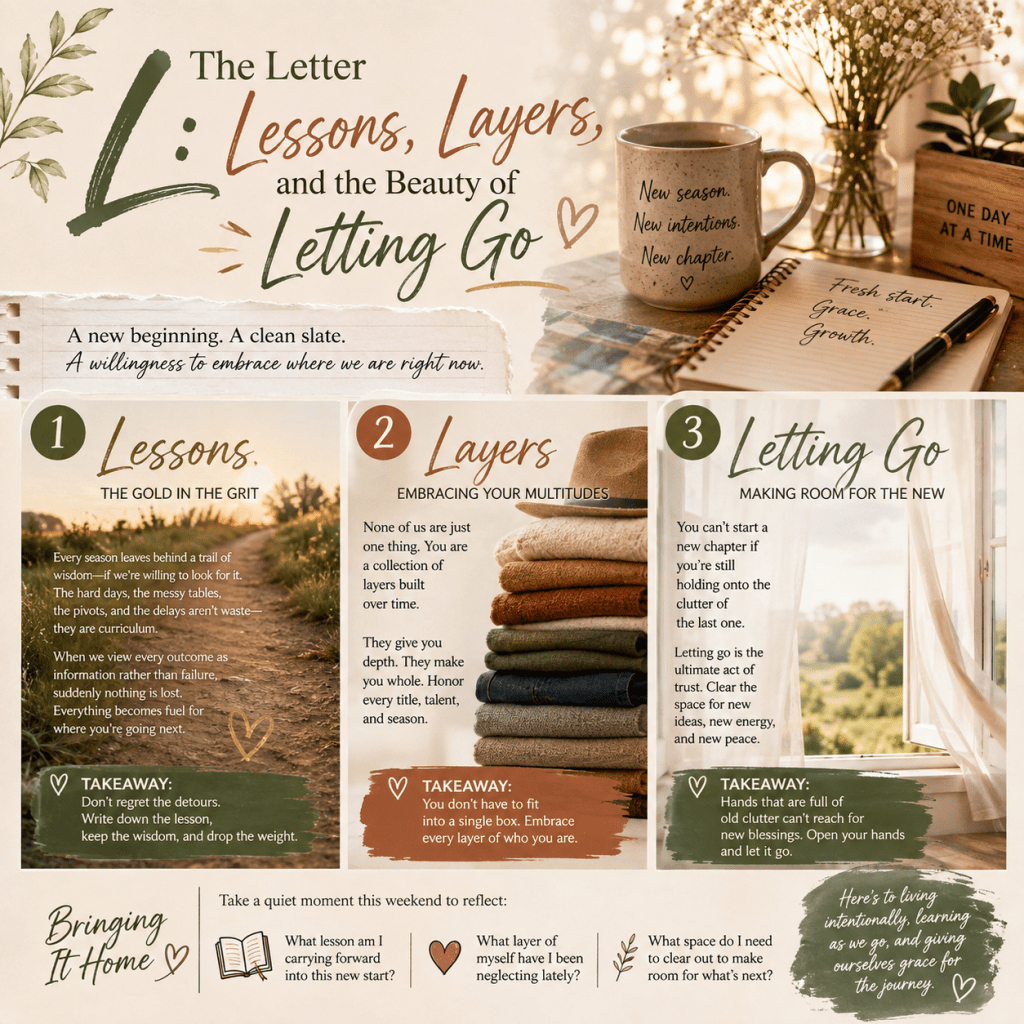
Spring Cleaning….House and Mind

Spring Cleaning Your Mind (And Your Stuff)


Spring equinox is here, and yes—it’s that magical time when the world starts fresh, the days get longer, and everything feels like it could use a good tidy. But here’s the thing: spring cleaning isn’t just for closets. It’s for your mind, your energy, your thoughts… and yes, even your memories.
I know, I know. Some of you are already feeling that panic: “Wait, if I let go of that hoodie, that memory disappears!” To my neurospicy friends—you KNOW exactly what I mean. The texture, the smell, the little stitch that makes you remember… it’s sticky. It feels like letting go of the thing is letting go of the story.
But here’s the truth: it’s not real. Memories live in your brain, your heart, and your soul—they don’t live in the item itself. You can absolutely keep the memory without keeping the clutter. That hoodie? The shoes? The ticket stub? They’re props. You’re the star of the story, not the accessory.
Why Letting Go Feels Hard
Objects, habits, even old thoughts—they cling. We hold onto them because they’re familiar, because they make us feel safe, or because our brain just really likes a good story. But here’s the catch: cluttered spaces, whether physical or mental, make it harder to breathe, to think, to be fully present.
Your Step-by-Step Mental Spring Cleaning
Pick a zone – Closet? Phone? Thoughts that keep looping? Start somewhere small.
Ask yourself – Does this serve me? Or am I holding it out of habit, guilt, or fear?
Let it go – Donate, recycle, delete, journal about it, take a picture… whatever makes it safe to release.
Celebrate the space – Notice how your energy shifts when there’s breathing room.
Reclaim & Renew
Letting go isn’t losing—it’s reclaiming. It’s saying, “I honor my memories, and I honor myself by making space for joy, growth, and intention.” That’s reclamation. That’s renewal. That’s you stepping into a season where you aren’t weighed down by what no longer serves you.
So here’s your challenge for the equinox: pick one thing today—a hoodie, a thought, a habit—and let it go. Notice the difference it makes when you reclaim that space for yourself.
Because spring isn’t just about cleaning the house—it’s about cleaning your mind, your heart, and your life. And yes… you can absolutely keep the memories without keeping the clutter.

A is for Addiction

Addiction.


Just sit with that word for a moment.
It carries weight. It sounds heavy. Shame-filled. Final. I can’t think of many positive things we associate with it.
I personally smoke cigarettes (working toward quitting), and I am absolutely a caffeine addict — and probably sugar too. But beyond my own habits, I have loved addicts. Not just romantically. Friends. Family. People I would go to the ends of the earth for.


So let’s ask the question plainly:
Is addiction a disease? A condition to be treated? Something recovery is possible from?
Yeah. Yes. It is.


What Is Addiction?
The American Society of Addiction Medicine defines addiction as:
A treatable, chronic medical disease involving complex interactions among brain circuits, genetics, the environment, and an individual’s life experiences. People with addiction use substances or engage in behaviors that become compulsive and often continue despite harmful consequences.


The National Institute on Drug Abuse explains it similarly — addiction is a chronic, relapsing disorder characterized by compulsive drug seeking and use despite negative consequences.
Chronic.
Medical.
Treatable.


Those words matter.


And here’s something else that matters:


In the United States, about 1 in 6 people struggle with a substance use disorder each year.
Millions more struggle with nicotine dependence.
Caffeine dependence is widely recognized.
Studies show that highly processed foods can trigger brain reward systems in ways similar to addictive substances.
This isn’t rare. This isn’t “those people.” This is us. Our neighbors. Our families.


We Joke About It… But Should We?
People casually say, “I’m a coffee addict.”
Or “I’m addicted to Diet Coke.”
Or “Don’t talk to me before my sugar.”
But do we understand the weight of that word?


Yes — you really can be addicted to sugar, caffeine, nicotine, and highly processed foods. That doesn’t make you weak. It makes you human with a brain wired for reward.
Our brains are designed to remember what feels good and to repeat it. Dopamine — the “feel good” neurotransmitter — reinforces behaviors that provide pleasure or relief. Over time, repetition becomes reliance. Reliance becomes dependence.
And dependence, when disrupted, becomes withdrawal.


The Logan Story
Let me tell you a story.
Logan was 10. His mom wasn’t much of a cook, so meals were mostly pre-packaged, fast food, convenient — and let me say clearly: fed is fed. No judgment. Survival comes first.
But when summer came, Logan went to stay with Dad and stepmom. They cooked fresh food. Fruits. Vegetables. Homemade meals. Grilled burgers and hot dogs.
Within days, Logan had what looked like the flu. Headaches. Fatigue. Irritability. Just not himself.
His big sister picked him up, took him to the movies and — yes — McDonald’s.
Miraculous recovery.
Until a week later, when the “flu” returned.
He wasn’t sick. He was withdrawing.
His body had become accustomed to high levels of sugar, sodium, and processed additives. When they disappeared, his system reacted.
Dad refused to reintroduce the fast food. They let his body recalibrate. It was uncomfortable. It was eye-opening. And it was very real.
Logan didn’t know he was dependent.
But his body did.


It’s All the Same Brain
Opioids.
Nicotine.
Methamphetamine.
Alcohol.
Sugar.
Caffeine.


Different substances. Same reward circuitry.
When we remove what the brain has grown used to, the body protests.


Withdrawal can look like:
Headaches
Fatigue
Anxiety
Irritability
Nausea
Depression
Physical pain


Some withdrawals are uncomfortable. Some are dangerous. Some are life-threatening.
But the mechanism? The brain wanting what it has been trained to expect.


So Where Do We Start?


We start by naming it.


Without shame.


We stop whispering about addiction like it’s a moral failure. We stop labeling people as “weak” or “lacking willpower.”
We start asking:
What pain is this numbing?
What pattern is this reinforcing?
What support is missing?
Addiction thrives in isolation. Recovery thrives in connection.
Somewhere, there has to be a conscious decision to become mindful of what we are putting into our bodies — and why.


Not with judgment.
With curiosity.


My Truth
I am a caffeine addict.
I am nicotine dependent.
I am working on both.
And I have loved addicts.


Deeply.


We need to help one another make better choices instead of judging someone’s struggle. Because it could be you. It could be me. It could be someone you love.
Addiction is not a character flaw.


It is a condition.
It is treatable.
Recovery is possible.


And compassion? That should be non-negotiable

The Weight of Empathy: Finding Balance in a Painful World

I oopsidentally published this on the wrong site Thursday. Check back Monday for more insight into the path I am on….Love and light ❤

Cautiously Optimistic: Navigating the Weight of Others’ Pain

I’ve often described myself as a cautiously optimistic person. It’s a way of being that helps me face the challenges of life with hope but without completely abandoning my awareness of how fragile things can be. I try to hold on to the belief that things will get better, that there is light at the end of every dark tunnel. Yet, beneath this cautious optimism is something much deeper—an empathy that can feel all-consuming. I feel everything, and when I say everything, I mean everything.

It’s as if my heart is finely attuned to the pain of the world. When I see someone struggling, whether it’s a close friend or a stranger, I feel their burden. I feel their sadness, their frustration, their fear. It’s hard to explain to those who don’t share this experience, but it’s almost as if I can physically feel their emotions in my own body. And with this heightened sense of empathy comes a natural desire to help. If I’m in, I’m all in. When someone I care about is hurting, I will do everything within my power to ease their pain. But here’s where the challenge lies: No matter how much I want to help, no matter how deeply I feel their suffering, I can’t fix everything.

And that’s the part that has become so difficult. Everywhere I go, I see people struggling. Whether it’s a friend facing a personal crisis, a family member dealing with loss, or a stranger encountering hardships I’ll never fully understand, it feels like there is a constant presence of pain in the world. It’s overwhelming at times. And as much as I want to be there for everyone, as much as I want to ease their suffering and show them that they are not alone, I feel a sense of helplessness that gnaws at me.

I think the hardest part is that the more I care, the more I absorb. I can’t turn off my empathy. When someone is hurting, I can’t just ignore it or pretend it doesn’t affect me. So, I carry these burdens with me. I hold space for others’ pain even when I have nothing left to give. This emotional weight becomes part of my daily existence, and sometimes, it feels like it’s a battle to simply get through the day without being overwhelmed.

Coping has become a process—a continuous, daily, and sometimes hourly, practice. I’ve learned to breathe through moments of heaviness, to step back and remind myself that it’s okay not to have all the answers. I’ve had to accept that my capacity to help is limited, that sometimes, the best thing I can offer is simply my presence, my listening ear, and my unwavering support. But that doesn’t always feel like enough. I want to do more—to take away the pain, to find a solution, to make it all better. The frustration of knowing that I can’t is, at times, unbearable.

But as I reflect on these feelings, I realize that my cautious optimism isn’t about ignoring the pain or pretending that everything is fine. It’s about holding space for hope, even in the face of suffering. It’s about recognizing that while I may not have the power to fix everything, I do have the ability to show up, to care, and to be a source of light in the lives of others.

The truth is, I may never be able to ease all of the burdens that I see around me, and that’s something I have to come to terms with. But I also believe that even the smallest acts of kindness, empathy, and support can make a difference. They may not erase the pain, but they can help carry it for a little while. And maybe, just maybe, that’s enough.

So, I’ll continue to navigate the world with this cautious optimism—holding space for the pain I encounter, but also holding space for the hope that one day, things will get better. I’ll keep doing what I can, even when it feels like it’s not enough, because I know that the journey of healing is a shared one. We may not always have the power to solve each other’s problems, but we can always choose to walk alongside each other, offering empathy, understanding, and love. And in the end, maybe that’s the most important thing we can do.