
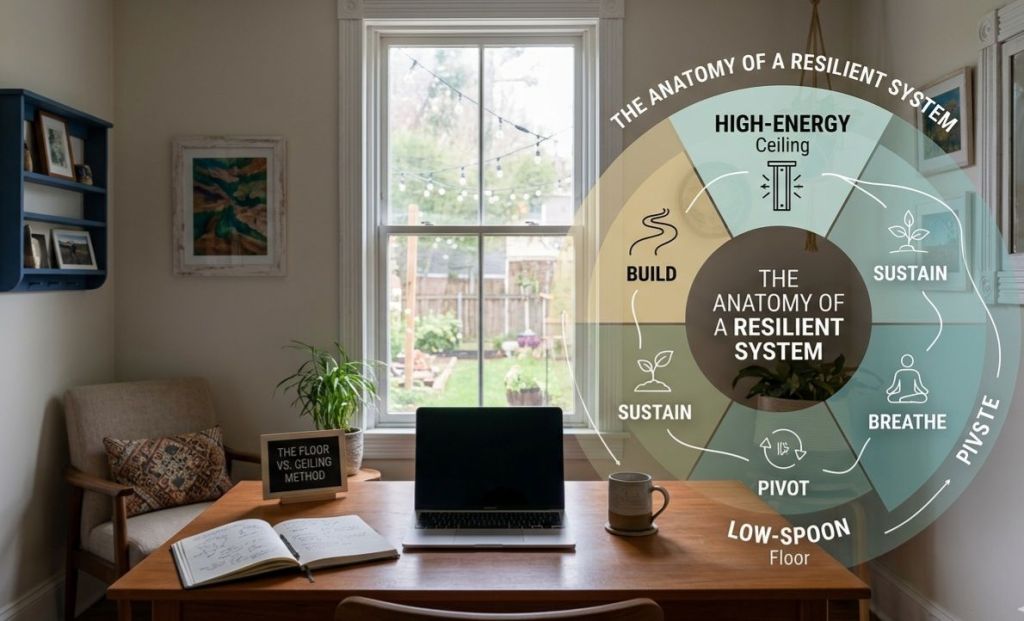
The Anatomy of a Resilient System: Building for the “Low-Spoon” Days


We’ve all been there. You sit down with a fresh cup of coffee and a master plan that could rival a military operation. You’ve got the categories, the color-coded blocks, and the ambition to build an empire by sunset.
But then, life happens. Or rather, the “energy tax” hits.
Maybe it’s a high-stress week, a string of late nights, or just one of those days where the mental “spoons” you started with have seemingly vanished by noon. Suddenly, that beautiful system you built feels like a judge, pointing a finger at everything you aren’t getting done.
That’s where the guilt creeps in. We start feeling like imposters in our own lives because we aren’t hitting the “ceiling” every single day.
The Trap of the “Perfect Version”
The biggest mistake we make when organizing our lives is building a system for the “perfect version” of ourselves—the one with boundless energy and zero distractions. But a system isn’t actually “better” if it only works when you’re at 100%.
A truly resilient system—one that actually moves the needle—is built for the person you are when you’re tired, foggy, and just trying to keep the wheels turning.
The Floor vs. The Ceiling
Think of your goals in two layers: The Ceiling and The Floor.
The Ceiling is your high-energy mode. This is where the heavy lifting happens—the deep creative work, the technical problem-solving, the “building” phase.
The Floor is your baseline. It’s the absolute bare minimum required to keep the momentum alive without burning out.
On low-energy days, your only job is to stay on the floor. If you can’t write the whole chapter, write one sentence. If you can’t reorganize the entire inventory, just clear one shelf. Success isn’t hitting the ceiling every day; it’s refusing to drop below the floor.
Choosing Your Focus (When You Only Have One Spoon Left)
When energy is low, we tend to panic and try to do a little bit of everything, which usually ends in doing nothing well. Instead, ask yourself: “Which one thing will make me feel the most ‘at peace’ tomorrow morning?”
Sometimes the most productive thing you can do is “Maintenance” rather than “Growth.” Pushing yourself to “build” when your tank is empty is like trying to drive a car on fumes—you’ll eventually stall out, and the recovery time will be twice as long.
Forgiving the “Invisible Work”
If you’re in a phase of life where you’re researching, planning, or laying foundations, it can feel like you have nothing to show for your effort. This is where the imposter syndrome thrives. It whispers that if there’s no finished product, the work didn’t happen.
Don’t listen.
The invisible work—the thinking, the organizing, the learning—is the infrastructure. You can’t hang the drywall until the frame is up. If today was a day for framing and not for decorating, that is still a win.
Building to Breathe
As you look at your week, ask yourself: Is my system a cage, or is it a support beam?
A better system doesn’t demand more of you; it manages what you have. It gives you permission to pivot when the spoons are low and the grace to ignore the guilt when you need to rest.
Build a system that breathes. Because you aren’t a machine, and your value isn’t measured by how many boxes you checked when you were running on empty.

Conquer Financial Stress: Budgeting Strategies for Mental Wellness

Too Much Month at the End of Your Money? Let’s Fix That

Money stress hits hard — and not just your wallet. It weighs on your mind, affects your mood, and can make even simple decisions feel overwhelming. If you’ve ever found yourself staring at your bank account wondering how there’s still so much month left at the end of your money, you are not alone.

The truth is, financial strain can take a serious toll on your mental health. But with the right plan, some practical tools, and a little bit of grace, you can turn that stress into confidence and stability.


Step One: Understand Where Your Money Is Going

Before you can get ahead financially, you have to get real about where your money is going. Start by dividing your spending into two main categories:

✅ Needs

The essentials that keep you and your family safe and secure — food, housing, clothing, transportation, insurance, and healthcare.

💸 Wants

The things that add fun, convenience, or comfort — eating out, streaming subscriptions, impulse purchases, hobbies, or luxury items.

When you clearly see the difference between needs and wants, you can make smarter choices about where your money goes — without feeling deprived.


Step Two: Create a Flexible Financial Game Plan

A budget shouldn’t feel like a punishment. It’s a tool that helps you take control. And I can help you build one that actually works for your lifestyle.

Here’s how we can start:

  • 🍲 Budget-friendly meal ideas that taste great and stretch your grocery dollars.
  • 🛒 Meal planning and prep strategies to save you time (and reduce stress).
  • 📱 Smart grocery hacks — couponing, delivery services, and avoiding impulse buys.
  • 💰 Insurance and legal guidance, from understanding coverage to writing your will.
  • 🧓 Retirement planning, even if you feel “behind.”

And when life throws a curveball — like a surprise car repair or medical bill — your plan should be strong and flexible enough to adjust without derailing your progress.


Step Three: Protect Your Mental Health

Money stress can creep into every corner of your life if you let it. That’s why it’s so important to take care of you while you’re taking care of your finances.

Here are a few simple ways to stay grounded:

  • Take a walk and get some fresh air.
  • Try deep breathing or shoulder rolls to release tension.
  • Do yoga or stretch for a few minutes.
  • And yes — go outside barefoot and touch grass. It really does help.

For me personally, grocery delivery has been a sanity-saver. I avoid impulse buys, stick to my list, and save time and energy. The delivery fee? Totally worth it. Plus, meal planning keeps our household running smoothly — we rarely eat out, and rotating a few favorite meals keeps things simple and affordable.


Step Four: Give Yourself Grace

Financial change doesn’t happen overnight. It’s about progress, not perfection. Some weeks will go smoothly, and others will feel messy — and that’s okay. What matters is that you’re trying, learning, and adjusting along the way.

Remember: you don’t have to do this alone.


Let’s Take the Stress Out of Your Finances — Together

If you’re tired of feeling overwhelmed and ready to take control of your money and your mental health, I’m here to help.

Whether you need:

  • A custom budget plan that fits your life
  • Affordable meal ideas and grocery strategies
  • Guidance on insurance, legal, or retirement planning

…I’ve got you. Let’s work together to build a plan that gives you peace of mind and helps you breathe easier — financially and emotionally.

👉 Schedule a Consultation : Julie Kilcrease

JKILCREASE@primerica.com United States Texas : ‪(254) 677-7510‬