
The Anatomy of a Resilient System: Building for the “Low-Spoon” Days


We’ve all been there. You sit down with a fresh cup of coffee and a master plan that could rival a military operation. You’ve got the categories, the color-coded blocks, and the ambition to build an empire by sunset.
But then, life happens. Or rather, the “energy tax” hits.
Maybe it’s a high-stress week, a string of late nights, or just one of those days where the mental “spoons” you started with have seemingly vanished by noon. Suddenly, that beautiful system you built feels like a judge, pointing a finger at everything you aren’t getting done.
That’s where the guilt creeps in. We start feeling like imposters in our own lives because we aren’t hitting the “ceiling” every single day.
The Trap of the “Perfect Version”
The biggest mistake we make when organizing our lives is building a system for the “perfect version” of ourselves—the one with boundless energy and zero distractions. But a system isn’t actually “better” if it only works when you’re at 100%.
A truly resilient system—one that actually moves the needle—is built for the person you are when you’re tired, foggy, and just trying to keep the wheels turning.
The Floor vs. The Ceiling
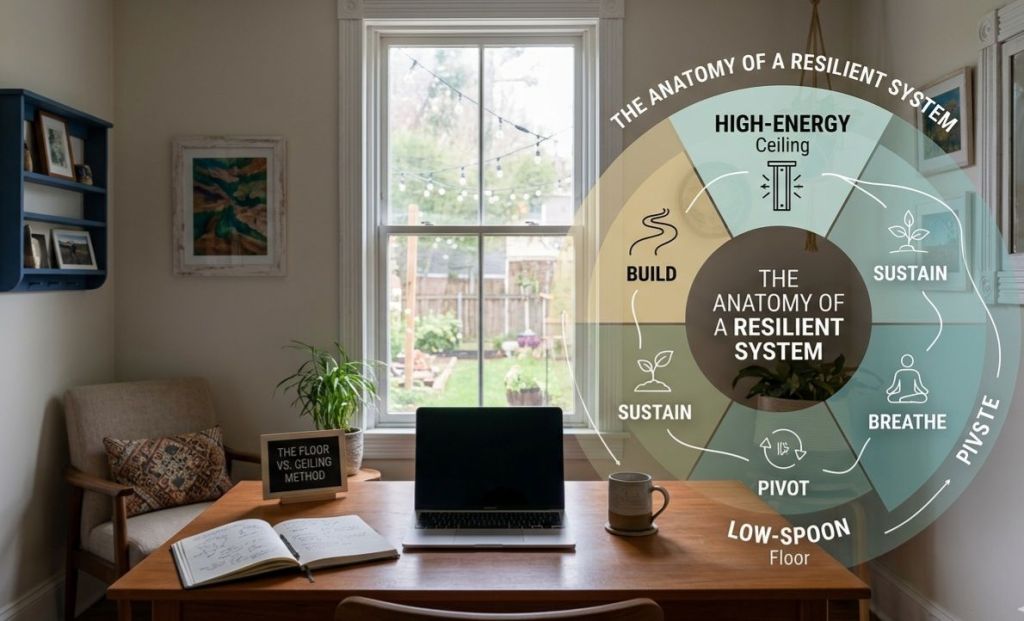
Think of your goals in two layers: The Ceiling and The Floor.
The Ceiling is your high-energy mode. This is where the heavy lifting happens—the deep creative work, the technical problem-solving, the “building” phase.
The Floor is your baseline. It’s the absolute bare minimum required to keep the momentum alive without burning out.
On low-energy days, your only job is to stay on the floor. If you can’t write the whole chapter, write one sentence. If you can’t reorganize the entire inventory, just clear one shelf. Success isn’t hitting the ceiling every day; it’s refusing to drop below the floor.
Choosing Your Focus (When You Only Have One Spoon Left)
When energy is low, we tend to panic and try to do a little bit of everything, which usually ends in doing nothing well. Instead, ask yourself: “Which one thing will make me feel the most ‘at peace’ tomorrow morning?”
Sometimes the most productive thing you can do is “Maintenance” rather than “Growth.” Pushing yourself to “build” when your tank is empty is like trying to drive a car on fumes—you’ll eventually stall out, and the recovery time will be twice as long.
Forgiving the “Invisible Work”
If you’re in a phase of life where you’re researching, planning, or laying foundations, it can feel like you have nothing to show for your effort. This is where the imposter syndrome thrives. It whispers that if there’s no finished product, the work didn’t happen.
Don’t listen.
The invisible work—the thinking, the organizing, the learning—is the infrastructure. You can’t hang the drywall until the frame is up. If today was a day for framing and not for decorating, that is still a win.
Building to Breathe
As you look at your week, ask yourself: Is my system a cage, or is it a support beam?
A better system doesn’t demand more of you; it manages what you have. It gives you permission to pivot when the spoons are low and the grace to ignore the guilt when you need to rest.
Build a system that breathes. Because you aren’t a machine, and your value isn’t measured by how many boxes you checked when you were running on empty.

The Second Half of the Season: Finding Our Bloom


There is a specific kind of quiet that happens right before spring really takes hold. In the songwriting world, we talk a lot about “the hook”—that moment where everything clicks and the story finds its rhythm. Life has those moments, too, but they often come after a season of being dormant.


As we move into late April, I’ve been thinking a lot about what it means to enter the “second half” of a journey. Whether it’s a creative project, a career shift, or just a new chapter in a family’s story, the transition isn’t always loud and flashy. Sometimes, it’s just a steady, quiet reclaiming of who you are meant to be.


Resilience in the Roots
In this part of the country, the earth is tough. It takes a certain kind of strength for a seed to push through that heavy soil. I think we’re a lot like that. We carry the weight of our past seasons—the winters that felt a little too long or the storms that shook our fences—but we still find a way to reach for the light.


Defining Your Narrative
One of the most powerful things we can do is decide how our story is told. For me, that’s happening through music and words, finding the melody in the transitions. But you don’t have to be a songwriter to rewrite your rhythm.
Listen to the change: What is the “new song” in your life right now?


Honor the growth: Even if you aren’t exactly where you planned to be, look at how far the roots have gone down.
Accept the timing: Some things bloom early; some take their time. Both are beautiful.
Looking Ahead


As the days get longer and the “Mother-Sense” kicks in, I’m leaning into the gratitude of being right here, right now. The heaviness of winter is lifting, and there is a lot of music yet to be written. And I am preparing for the worst and hoping for the best. ❤️


How are you finding your rhythm this month? Is there a part of your story that is finally starting to bloom?

Do you have things you need to protect if the storms do come??

Let’s chat!

Spring in the Kitchen: From Garden Fresh to Family Favorites


As the Texas sun begins to warm up that “black waxy” prairie soil and the evenings stay light a little longer, our appetites naturally start to shift. We find ourselves craving the crisp snap of fresh greens, yet we aren’t quite ready to give up those comforting staples that make a house feel like a home.
Planning for the next few weeks is all about balance—celebrating the new growth of the season while keeping the “tried and true” favorites on the table. Here is a curated guide to spring eating that bridges the gap between light, seasonal fare and soul-warming classics.
The Seasonal Stars: Fruits & Veggies
Spring produce is all about brightness and texture. Right now, keep an eye out for:


Strawberries: At their peak of sweetness.
Asparagus & Snap Peas: Perfect for a quick sauté or adding crunch to salads.


Radishes: Providing a peppery bite to balance out sweeter dressings.


Blog Tip: Try a Strawberry & Spinach Poppyseed Salad. It’s vibrant, festive, and looks beautiful on a spring table.
Lighter Bites: Springtime Pasta Salads


Pasta salads are the ultimate “bridge” food. They are filling enough to satisfy but cool enough for a 75-degree afternoon.
Lemon-Asparagus Orzo: This is spring in a bowl. The citrus zest cuts through the richness of the feta, and the tender asparagus tips keep it feeling fresh.


Garden Primavera Macaroni: Take your standard macaroni salad and load it with every crunchy vegetable you can find—cucumbers, bell peppers, and broccoli florets.


The Comfort Staples
Even as we move toward warmer temps, some nights just call for a “staple” dinner. These are the recipes that ground us:
Classic Chicken and Dumplings: It’s a year-round essential. To give it a springtime lift, be generous with fresh parsley and a squeeze of lemon in the broth to keep the flavors “up.”
Sheet-Pan Lemon Herb Chicken: If you want the comfort of a roast without the heavy cleanup, toss chicken thighs, new potatoes, and spring carrots onto a single sheet pan.


The “Dump & Go” Finale
Sometimes the best part of spring is spending more time outside and less time hovering over the oven. Enter the Dump Cake. It’s the ultimate low-effort, high-reward dessert.
The Peach & Berry Twist: Layer canned peaches and frozen blueberries in a 9×13 dish.


The Topping: Sprinkle a yellow cake mix evenly over the fruit.


The Finish: Place thin pats of butter over the entire surface and bake until the fruit is bubbling and the top is golden-brown.


A Note for the Hand-Bakers
If you’re still reaching for the flour bin to knead a fresh loaf of sandwich bread, keep an eye on the rising humidity! Texas spring weather can make your dough a bit stickier than it was in February. Trust your hands—a little extra dusting of flour during the kneading process will keep things moving smoothly.


What are you most excited to cook this spring? Drop a comment below and let’s swap seasonal secrets!

Love and light Julie

Scraps, Spirals, and the Strength of a Rolling Pin


**Amazon affiliate links included**

If you walked into my kitchen today, you wouldn’t find a Pinterest-perfect setup with high-end gadgets. You’d find a dusting of all-purpose flour on the counter and me with a rolling pin in hand.
I’ve never been much for the “easy way” out. Whether it’s pressing out tortillas by hand or hand-stitching a memory quilt for my son, I like to feel the work. There’s a rhythm to using a pastry blender to cut the fat into the flour—a steady, grounding pace that helps clear the “topsy-turvy” noise of the week.


The “Spiral” Songwriter
While the dough is rising, I’m usually reaching for a notebook. But you won’t find any fancy leather-bound journals here. My catalog of 180+ songs started on the back of index cards and old student spirals left over from my teaching years.


There’s something about a scrap of paper that makes the lyrics feel more honest. It doesn’t have to be pretty to be powerful. It just has to be true.


The Tech Pivot: KitchenIQ
Even with my “old school” heart, I’m still a believer in moving forward. That’s why I’m building KitchenIQ. I’m taking all those scratch-made traditions and my “Grandmama” hacks and putting them into an app that actually understands a busy household. I’m learning FlutterFlow the same way I learned to bake—one step at a time, failing until it’s right, and not being afraid to get my hands a little dirty.


Living the “Second Half”
I spent a long time throwing myself into projects as a distraction. But today, whether I’m studying for my General Lines license, coding an app, or rolling out dough, I’m doing it with intention.


Life is too darn short to wait for the “perfect” tools. You use the flour you have, the scraps you can find, and the rolling pin your mama probably used. You just start.
Julie’s “Old School” Kitchen Favorites:


The Pastry Blender:    — This is the workhorse of my kitchen. Simple, effective, and doesn’t need a plug. I had to replace my old one I found at a thrift shop, it had a wooden handle…But I do enjoy the upgrade with the biscuit cutter and dough blade for splitting tortilla dough or making rolls.


A Solid Wood Rolling Pin:  — Sometimes the simplest tools are the ones that last a lifetime. I do enjoy a good thrift find but the best is marble for tortillas and pie crusts, but that wood for the biscuits and breads. Either one works well or if you can have both, why not?


Bulk All-Purpose Flour: — Proof that you don’t need fancy ingredients to make something people love. You can get a great 25 lb bag on Amazon, but I also get it from HEB or Wal Mart in 10lb bags, depending on how much baking I intend to do in any given period of time.

As Cody Johnson sang so well :

“If you got a chance, take it, take it while you got a chance
If you got a dream, chase it, ’cause a dream won’t chase you back
If you’re gonna love somebody
Hold ’em as long and as strong and as close as you can
‘Til you can’t”

Go chase dreams, be the light, change the world, protect the children…..

Always Julie

Mom Burnout Doesn’t Always Look Like Breaking Down


When people talk about burnout, they usually picture someone falling apart.

Crying.
Snapping.
Completely overwhelmed and unable to keep going.

And sometimes it does look like that.

But sometimes it doesn’t.

Sometimes burnout is quiet.

It looks like getting up every day and doing exactly what needs to be done, but feeling nothing while you do it.
It looks like checking the boxes, answering the calls, making the meals, showing up for everyone… and still feeling like you are not really there.

Not sad enough to fall apart.
Not okay enough to feel at peace.

Just somewhere in the middle.

Stuck.

I think that version of burnout is harder to recognize, because from the outside, everything looks fine.

You are still functioning.
The house is still running.
The kids are still cared for.
Life is still moving forward.

But inside, something feels off.

You are tired in a way that sleep does not fix.
You are overwhelmed in a way that is hard to explain.
You are needed constantly, and somehow still feel invisible.

And then comes the guilt.

Because how do you admit you are burned out when you are still doing everything you are supposed to do?

How do you say you are struggling when nothing is technically falling apart?

So you don’t.

You push it down.
You tell yourself other people have it harder.
You remind yourself to be grateful.

And you keep going.

That is what a lot of mom burnout actually looks like.

It is not always a breaking point.

Sometimes it is a slow fading.

A quiet losing of yourself in the middle of taking care of everyone else.

A life that starts to feel more like responsibility than something you are living.

And the hardest part is, you can stay there for a long time.

Because nothing forces you to stop.

There is no clear moment where everything crashes and demands your attention.

There is just that quiet voice in the back of your mind that says, something is not right.

If you are in that place, I want you to hear this.

You do not have to fall apart for your burnout to be real.

You do not have to earn rest by reaching a breaking point.

You are allowed to acknowledge that you are tired.
You are allowed to admit that something feels off.
You are allowed to need more than just getting through the day.

Not every season is meant to feel full and meaningful and balanced.

Some seasons are heavy.

But you are still in there somewhere.

Even if you feel a little disconnected.
Even if you are just going through the motions right now.

This is not the end of you.

It is a signal.

A quiet one, maybe.
But an important one.

And maybe the next step is not fixing everything all at once.

Maybe it is just noticing.

Maybe it is just being honest with yourself.

Maybe it is just giving yourself permission to say, this is harder than I thought it would be.

That matters.

More than you think.