
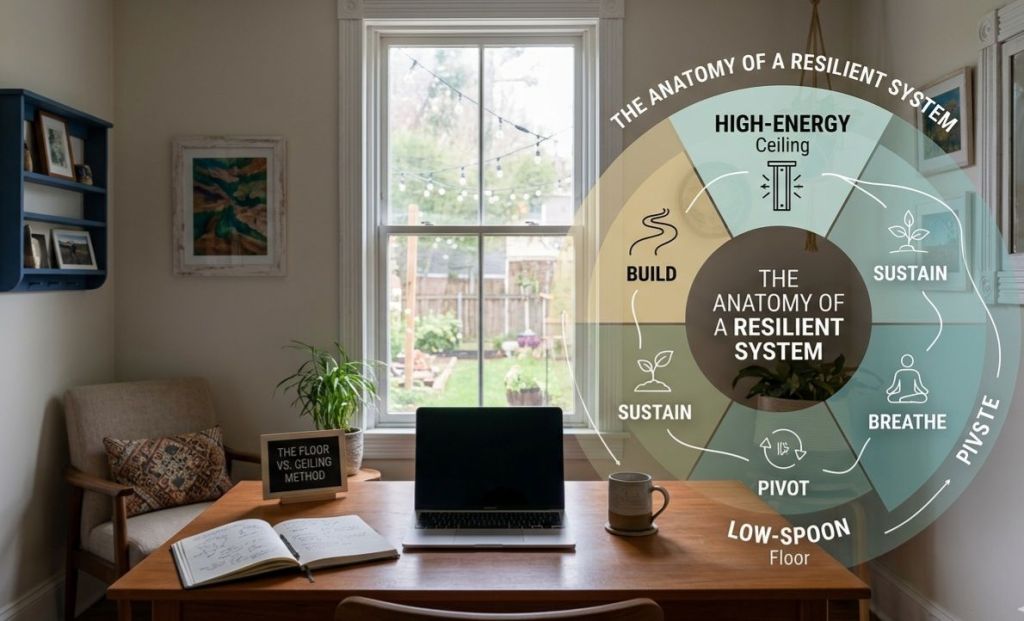
The Anatomy of a Resilient System: Building for the “Low-Spoon” Days


We’ve all been there. You sit down with a fresh cup of coffee and a master plan that could rival a military operation. You’ve got the categories, the color-coded blocks, and the ambition to build an empire by sunset.
But then, life happens. Or rather, the “energy tax” hits.
Maybe it’s a high-stress week, a string of late nights, or just one of those days where the mental “spoons” you started with have seemingly vanished by noon. Suddenly, that beautiful system you built feels like a judge, pointing a finger at everything you aren’t getting done.
That’s where the guilt creeps in. We start feeling like imposters in our own lives because we aren’t hitting the “ceiling” every single day.
The Trap of the “Perfect Version”
The biggest mistake we make when organizing our lives is building a system for the “perfect version” of ourselves—the one with boundless energy and zero distractions. But a system isn’t actually “better” if it only works when you’re at 100%.
A truly resilient system—one that actually moves the needle—is built for the person you are when you’re tired, foggy, and just trying to keep the wheels turning.
The Floor vs. The Ceiling
Think of your goals in two layers: The Ceiling and The Floor.
The Ceiling is your high-energy mode. This is where the heavy lifting happens—the deep creative work, the technical problem-solving, the “building” phase.
The Floor is your baseline. It’s the absolute bare minimum required to keep the momentum alive without burning out.
On low-energy days, your only job is to stay on the floor. If you can’t write the whole chapter, write one sentence. If you can’t reorganize the entire inventory, just clear one shelf. Success isn’t hitting the ceiling every day; it’s refusing to drop below the floor.
Choosing Your Focus (When You Only Have One Spoon Left)
When energy is low, we tend to panic and try to do a little bit of everything, which usually ends in doing nothing well. Instead, ask yourself: “Which one thing will make me feel the most ‘at peace’ tomorrow morning?”
Sometimes the most productive thing you can do is “Maintenance” rather than “Growth.” Pushing yourself to “build” when your tank is empty is like trying to drive a car on fumes—you’ll eventually stall out, and the recovery time will be twice as long.
Forgiving the “Invisible Work”
If you’re in a phase of life where you’re researching, planning, or laying foundations, it can feel like you have nothing to show for your effort. This is where the imposter syndrome thrives. It whispers that if there’s no finished product, the work didn’t happen.
Don’t listen.
The invisible work—the thinking, the organizing, the learning—is the infrastructure. You can’t hang the drywall until the frame is up. If today was a day for framing and not for decorating, that is still a win.
Building to Breathe
As you look at your week, ask yourself: Is my system a cage, or is it a support beam?
A better system doesn’t demand more of you; it manages what you have. It gives you permission to pivot when the spoons are low and the grace to ignore the guilt when you need to rest.
Build a system that breathes. Because you aren’t a machine, and your value isn’t measured by how many boxes you checked when you were running on empty.

The Weight of Worry

Understanding the Challenges Our Children Face: A mom’s thoughts

Can we talk about the hard stuff? It’s not just the occasional worries that gnaw at us; it’s the deep, pervasive concerns that accompany the journey of parenting. As I reflect on my experiences, I can’t help but think about the realities that many parents face today. I know people who have struggled with addiction—individuals who have turned to pills and alcohol to cope with life’s pressures, whether stemming from joy or despair. I’ve witnessed young lives teetering on the edge, grappling with challenges so overwhelming that they felt as though they had no choice but to escape from this world.

Consider this: According to the National Institute on Drug Abuse (NIDA), nearly 70% of young adults aged 18-25 have reported using alcohol in the past month, with about 16% indicating binge drinking. Furthermore, the Substance Abuse and Mental Health Services Administration (SAMHSA) found that in 2021, over 4.6 million young adults reported misusing prescription medications. These statistics remind us that our children, even when they seem resilient, are navigating a landscape fraught with peril.

As we watch our children transition from adolescence into adulthood, the reality hits hard: there comes a point when we can no longer protect them from every danger. They bear the scars of childhood scrapes and bumps, yet the fear of what lies ahead weighs heavily on our hearts.

As a mother, I often find myself plagued by doubts. Did I do enough to prepare them for the challenges of life? Will the world embrace them as they carve out their own paths? Have I equipped them with the tools to trust their instincts and steer clear of harmful situations? Will they have the courage to make sound choices, even when faced with peer pressure or societal expectations? These questions swirl in my mind, casting a shadow over the proud moments I should be savoring.

The American Psychological Association reports that around 30% of adolescents experience significant anxiety or stress related to social pressures and academic expectations. For those aged 18-25, the transition to adulthood is often riddled with anxiety about career prospects, financial independence, and relationships. As parents, we want to instill confidence and resilience, yet we must acknowledge that external factors can overwhelm even the most well-prepared young adults.

Moreover, mental health concerns are on the rise. The National Alliance on Mental Illness (NAMI) states that approximately 1 in 5 adults in the U.S. experience mental illness in a given year. This means that our children, aged 14 to 30, are at a higher risk of facing issues such as depression and anxiety, which can lead to more severe consequences if not addressed.

It’s crucial to foster an open dialogue with our children, creating a safe space where they feel comfortable sharing their struggles. We need to remind them that it’s okay to seek help and that support is always available. As parents, we must strive to be the guiding light in their lives, offering them not just advice but also unconditional love and understanding.

In moments of self-doubt, I remind myself that while I may not be able to shield my children from every hardship, I can be their anchor. I can provide them with the strength to face life’s uncertainties, encouraging them to reach out when they need support. They must know they can always come to me, no matter what challenges they encounter.

Ultimately, the journey of parenting is filled with ups and downs, and while the worries may never fully dissipate, we can arm our children with the resilience to navigate the world on their own. By fostering open communication, teaching them the importance of mental health, and instilling values that promote healthy decision-making, we can help them forge paths that lead to fulfilling lives. Let’s embrace these conversations, even when they’re difficult, and commit to being present for our children as they grow into the remarkable individuals they are meant to be.