
The Letter L: Lessons, Layers, and the Beauty of Letting Go


Today marks a fresh page in the notebook. If you caught my post Saturday August 1,  on A New Beginning, you know we are stepping into this season with fresh intention, a clean slate, and a willingness to embrace where we are right now.
As we keep moving through our alphabetical journey, we’ve arrived at L. And honestly? It couldn’t have come at a better time. Life isn’t linear—it’s full of turns, unexpected shifts, and quiet victories. Today, we’re unpacking three “L” words that help us make sense of the journey and keep us grounded as we build what’s next.
1. Lessons (The Gold in the Grit)
Every season leaves behind a trail of wisdom—if we’re willing to look for it. The hard days, the messy kitchen tables, the pivots in our plans, and the unexpected delays aren’t waste; they are curriculum.
When we look back on where we’ve been, the goal isn’t to linger on what went wrong, but to gather up the lessons. What did that challenging week teach you about your boundaries? What did that creative block teach you about rest? When you view every outcome as information rather than failure, suddenly nothing is lost. Everything becomes fuel for where you’re going next.
Takeaway: Don’t regret the detours. Write down the lesson, keep the wisdom, and drop the weight.
2. Layers (Embracing Your Multitudes)
None of us are just one thing. You aren’t just defined by your day job, your family role, your creative side projects, or your past. You are a collection of layers built over time.
Sometimes we feel pulled in a dozen directions because we carry so many different passions and responsibilities. But here’s the beauty of layers: they give you depth. The patience you practice in one area of your life feeds into your creative work. The organizational systems you build for your home give you the freedom to dream bigger. Embrace all the different titles and talents you carry—they don’t make you scattered; they make you whole.
Takeaway: You don’t have to fit into a single box. Give yourself permission to honor every layer of who you are today.
3. Letting Go (Making Room for the New)
You can’t start a new chapter if you’re still holding onto the clutter of the last one. Whether it’s physical space, old expectations, or the pressure to have everything figured out by Monday morning, letting go is the ultimate act of trust.
As we launch into this new season, take a look around your desk, your calendar, and your mind. What are you holding onto simply out of habit? What mental tabs can you close today? When you clear out what isn’t serving your current season, you create the quiet space needed for new ideas, new energy, and new peace to settle in.
Takeaway: Hands that are full of old clutter can’t reach for new blessings. Open your hands and let it go.
Bringing It Home Today
As you move through this weekend, take a quiet moment over your morning coffee or evening wind-down to ask yourself:
What lesson am I carrying forward into this new start?
What layer of myself have I been neglecting lately?
What space do I need to clear out to make room for what’s next?
Here’s to living intentionally, learning as we go, and giving ourselves grace for the journey.
K is for Kitchen, Keepsakes, and Kinetic Energy


We are stepping back into our alphabet journey today, landing right on the letter K. After celebrating the roots and wings of my songwriting last week, it’s time to bring our focus back to the immediate spaces we inhabit—especially when we are managing our capacity.
When you’re navigating health challenges, perimenopause, or the heavy weight of a shifting season, the physical world around you can start to feel like a demanding boss. That’s why we need to talk about three words that change how we interact with our immediate environment: Kitchen, Keepsakes, and Kinetic Energy.
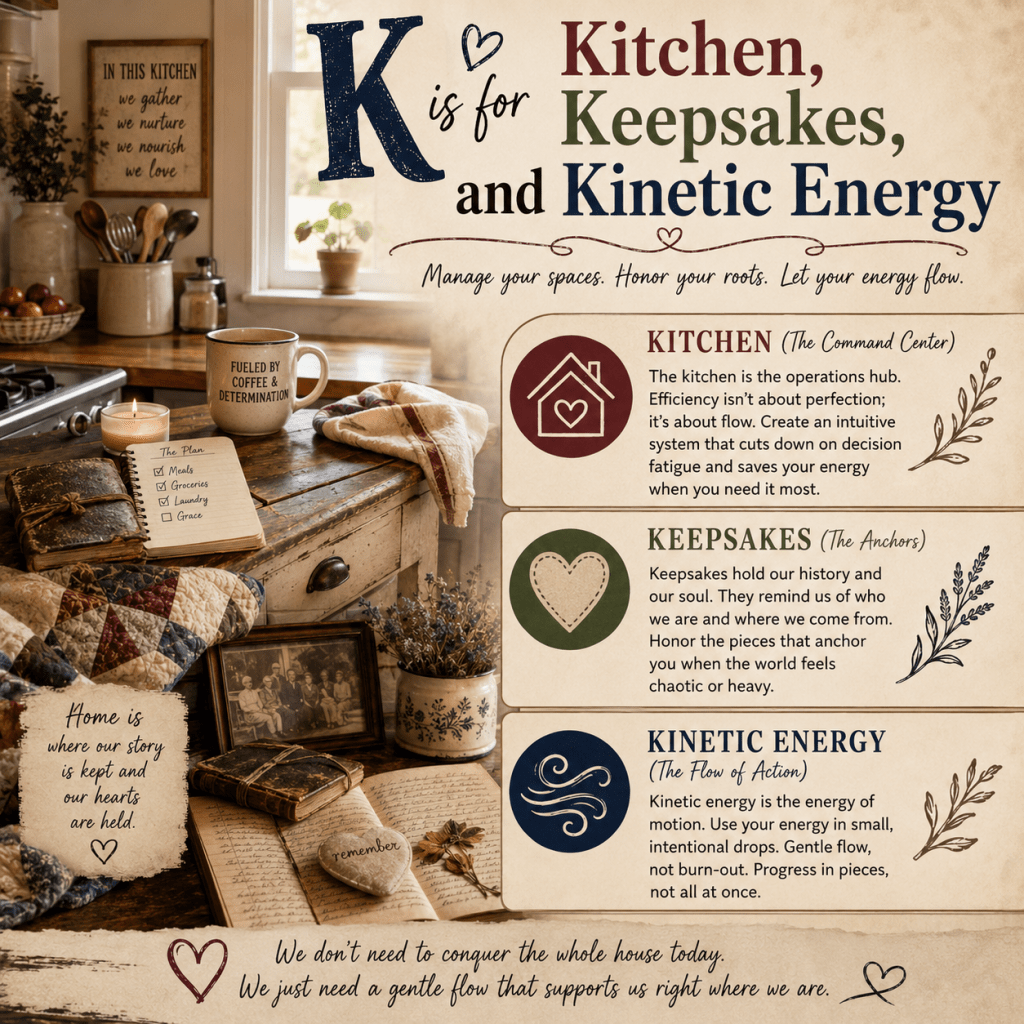
Kitchen (The Command Center): They say the kitchen is the heart of the home, but let’s be honest—it’s the operations hub. Between meal prep, groceries, and feeding a crowd, it takes a lot of mental labor to keep it running. True efficiency here isn’t about color-coded containers; it’s about creating an intuitive flow that cuts down on decision fatigue. When your kitchen has a smart system, it works for you, saving your precious energy when you need it most.
Keepsakes (The Anchors): A home shouldn’t just be functional; it needs to hold your soul. Keepsakes are the tangible pieces of our history—the hand-stitched quilts, the old notebooks, the reminders of loved ones lost that line our shelves. Tending to our keepsakes isn’t about dusting clutter; it’s about honoring the roots that hold us steady. When the world outside feels chaotic or our bodies force us to pause, these pieces remind us of who we are.
Kinetic Energy (The Flow of Action): Kinetic energy is the energy of motion. When you have a “full steam ahead” personality, you want to use your energy in massive bursts—deep-cleaning the whole house or tackling huge projects all at once. But when you are healing, you have to learn to manage your kinetic energy in small, intentional drops. It’s the five-minute counter sweep, or the slow preparation of a single meal. It’s letting the energy flow gently, rather than burning it all out in a single match-strike.
True “mother-sense” is knowing how to balance the management of our physical spaces with the reality of our physical strength. We don’t need to conquer the whole house today. We just need to create a gentle flow that supports us right where we are.
This week, look at your command center. How can you shift the energy in your kitchen or spend a quiet moment with a keepsake to bring a little more peace to your Monday?

J is for Journey, Joy, and Justification

J


We are stepping back into our alphabet journey today, landing right on the letter J. After a weekend of practicing the “Friday Freedom Exhale”—where we gave ourselves permission to do everything or absolutely nothing—stepping back into Monday can feel a bit jarring.
When you’re navigating health challenges or the erratic shifts of midlife, the pressure to “get back to it” on a Monday morning is heavy. That’s why we need to talk about three words that change how we approach our progress: Journey, Joy, and Justification.
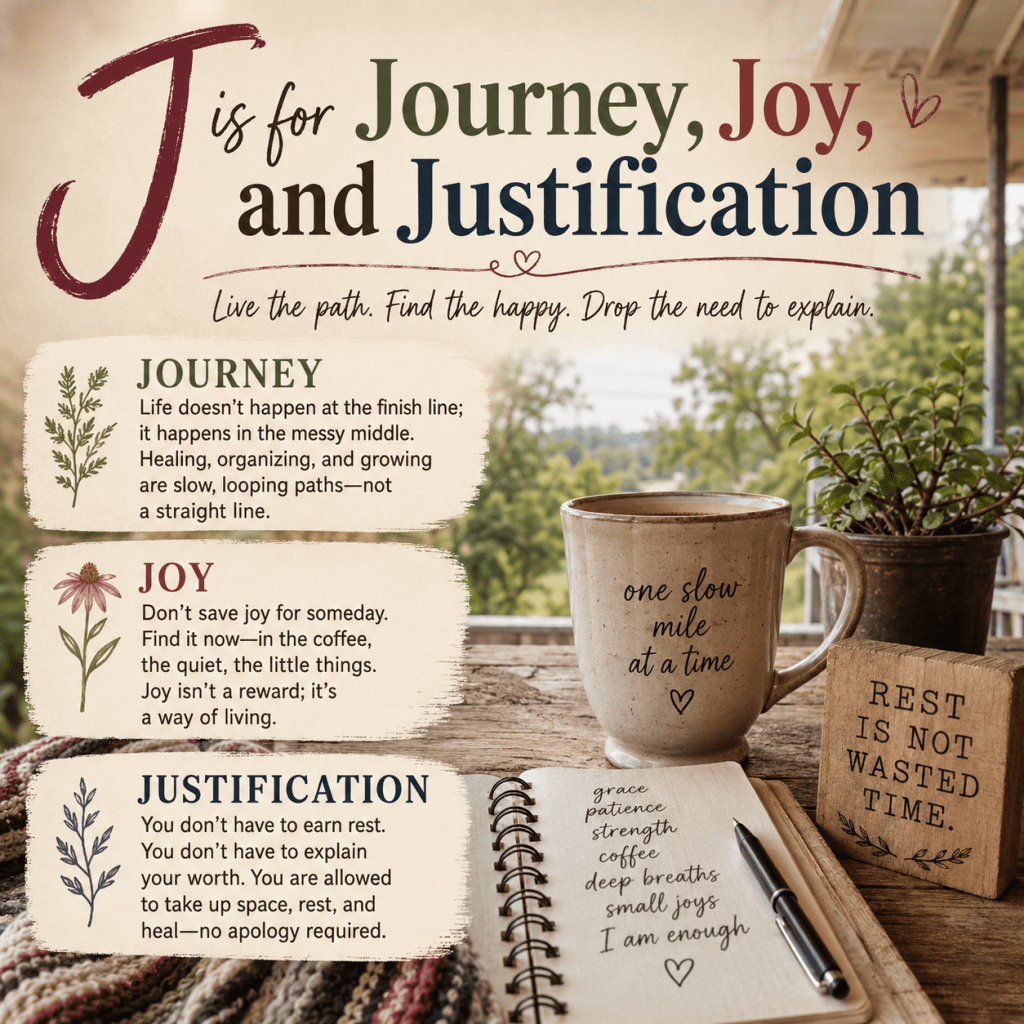
Journey: When you have a “full steam ahead” personality, you are naturally obsessed with the destination. You want the completed project, the perfectly organized space, or the day when your health finally feels 100% predictable again. But life doesn’t happen at the finish line; it happens entirely in the messy middle. Embracing the journey means accepting that healing, organizing, and growing are slow, looping paths—not a straight line.
Joy: We often treat joy like a reward we get after we finish the hard work. “I’ll enjoy myself when the house is perfect, or when I feel better.” But true “mother-sense” tells us that we have to find pockets of joy right in the middle of the unfinished business. It’s finding joy in a hot cup of coffee even if the living room is a mess, or enjoying a quiet moment on the porch even if your body is forcing you to sit out the next round.
Justification: This is the most important one for today. You do not need to justify your existence by your productivity. You do not need to justify taking a step back, taking a nap, or putting a big project on hold. Your worth isn’t tied to how much steam you are running on. You are allowed to take up space, rest, and heal without offering an explanation or an apology to anyone—including yourself.
This week, let’s stop treating our lives like a race to be won. Let’s focus on the journey we are actually on, look for the quiet joy hidden in the pauses, and completely drop the need to justify our rest.
Take it one slow mile at a time this week.

The Work Done in the Dark


On Monday, we talked about the mental health ABCs—the tools, the structure, the visible strategies. But if we are honest, sometimes you practice the steps, you do the work, and… nothing seems to change. The surface of your life still looks just as dry, cracked, or foggy as it did before.
It’s easy to feel like you’re failing when you don’t see immediate results. But real growth doesn’t start in the sun. It starts in the dark.
Think about a seed. When it’s buried in the dirt, there are no leaves yet. There are no fruits, no deep roots, no visible proof of life. To anyone looking from the outside, it looks like a whole lot of nothing. But underneath the surface, that seed is active. It’s germinating, shifting, and doing exactly what it needs to do to build a foundation. It is preparing to break through.
Every flower blooms on its own timeline, and every human is a unique, imperfectly perfect creation. We can’t force the season, and we can’t copy someone else’s timeline.
Country artist Eric Church recently spoke to a crowd of graduates and said something that cuts right to the heart of this. He told them that the world doesn’t need more cover songs—it needs your voice. It needs your unique perspective.
Trying to rush your healing or mimic someone else’s visible success is just playing a cover song. Your growth is allowed to be quiet. It is allowed to take time. The unseen work you are doing right now to take care of your mind, to protect your peace, and to just hold on in the quiet—that matters.
The seeds we plant in the dark will not grow overnight. But if you give them time, one day you will get to enjoy the beauty of the work that seed did before it ever even saw the light.
Be patient with your timeline this weekend. You are still growing, even when it’s quiet.

The Anatomy of a Resilient System: Building for the “Low-Spoon” Days


We’ve all been there. You sit down with a fresh cup of coffee and a master plan that could rival a military operation. You’ve got the categories, the color-coded blocks, and the ambition to build an empire by sunset.
But then, life happens. Or rather, the “energy tax” hits.
Maybe it’s a high-stress week, a string of late nights, or just one of those days where the mental “spoons” you started with have seemingly vanished by noon. Suddenly, that beautiful system you built feels like a judge, pointing a finger at everything you aren’t getting done.
That’s where the guilt creeps in. We start feeling like imposters in our own lives because we aren’t hitting the “ceiling” every single day.
The Trap of the “Perfect Version”
The biggest mistake we make when organizing our lives is building a system for the “perfect version” of ourselves—the one with boundless energy and zero distractions. But a system isn’t actually “better” if it only works when you’re at 100%.
A truly resilient system—one that actually moves the needle—is built for the person you are when you’re tired, foggy, and just trying to keep the wheels turning.
The Floor vs. The Ceiling
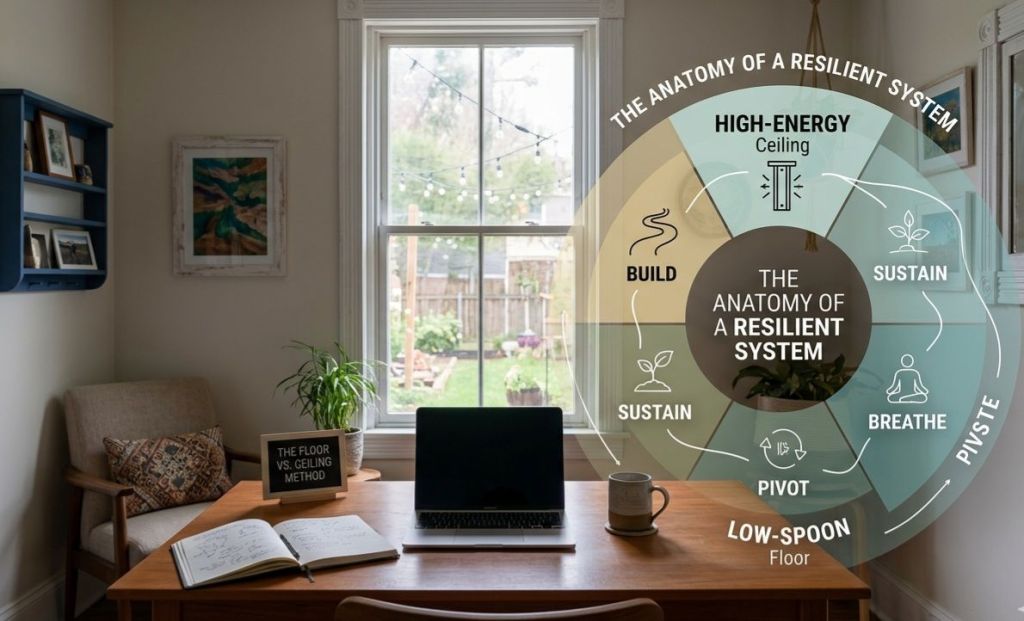
Think of your goals in two layers: The Ceiling and The Floor.
The Ceiling is your high-energy mode. This is where the heavy lifting happens—the deep creative work, the technical problem-solving, the “building” phase.
The Floor is your baseline. It’s the absolute bare minimum required to keep the momentum alive without burning out.
On low-energy days, your only job is to stay on the floor. If you can’t write the whole chapter, write one sentence. If you can’t reorganize the entire inventory, just clear one shelf. Success isn’t hitting the ceiling every day; it’s refusing to drop below the floor.
Choosing Your Focus (When You Only Have One Spoon Left)
When energy is low, we tend to panic and try to do a little bit of everything, which usually ends in doing nothing well. Instead, ask yourself: “Which one thing will make me feel the most ‘at peace’ tomorrow morning?”
Sometimes the most productive thing you can do is “Maintenance” rather than “Growth.” Pushing yourself to “build” when your tank is empty is like trying to drive a car on fumes—you’ll eventually stall out, and the recovery time will be twice as long.
Forgiving the “Invisible Work”
If you’re in a phase of life where you’re researching, planning, or laying foundations, it can feel like you have nothing to show for your effort. This is where the imposter syndrome thrives. It whispers that if there’s no finished product, the work didn’t happen.
Don’t listen.
The invisible work—the thinking, the organizing, the learning—is the infrastructure. You can’t hang the drywall until the frame is up. If today was a day for framing and not for decorating, that is still a win.
Building to Breathe
As you look at your week, ask yourself: Is my system a cage, or is it a support beam?
A better system doesn’t demand more of you; it manages what you have. It gives you permission to pivot when the spoons are low and the grace to ignore the guilt when you need to rest.
Build a system that breathes. Because you aren’t a machine, and your value isn’t measured by how many boxes you checked when you were running on empty.