H is for Habits, Home, and Harmony


Following up on our reflection about the “Three Gs” and the reality of a forced pause, I’ve been thinking a lot about what happens after you hit the brakes. When you’re used to running full steam ahead, a sudden slowdown can make you feel completely untethered. The grand routines and massive project plans you mapped out suddenly feel impossible to touch.
That is exactly where the beautiful intersection of Habits, Home, and Harmony comes in.
When life is running smoothly, we tend to treat habits like productivity hacks to get more done. But when you are dealing with health challenges, unexpected grief, or the heavy weight of a shifting season, habits look entirely different. They cease to be a checklist for achievement and instead become the gentle framework that protects your peace.
True “mother-sense” isn’t about maintaining a rigid, unbreakable schedule when your body or heart is screaming for rest. It’s about creating harmony in the space you inhabit.
When your big plans are paused, try shifting your focus to these three connected pillars:
Habits ⚓️(The Anchors): When you can’t run full steam, let your habits shrink to match your actual capacity. It’s no longer about a massive morning routine; it’s just sitting with a hot mug for five minutes of intentional quiet, or a tiny, five-minute evening sweep to clear off one countertop. These small acts are the quiet evidence that you are still tending to your world.
Home 🏡(The Sanctuary): Your home shouldn’t feel like a demanding boss with a never-ending list of chores—especially when you are trying to heal. Right now, let your home be a soft place to land. Organizing and maintaining order isn’t about perfection; it’s about creating a space that wraps its arms around you and gives your mind a quiet place to rest.
Harmony 🎶(The Flow): Harmony is what happens when your habits and your home align with your current reality, rather than your expectations. It’s the sweet spot where you stop fighting the pause and instead learn to flow with it. It’s knowing when to tighten up the systems and when to simply let things be, trusting that the balance will return.
When you can’t run, these small focus areas ensure you don’t drift away. They keep your spirit in order while your body catches up.
If you are navigating a season of forced rest or shifted expectations, let go of the pressure to conquer the world. Turn inward. Look at your immediate surroundings. What is one tiny, comforting habit you can practice today to bring a little more harmony into your home?

G is for Grief, Grace, and Gratitude…


When I started mapping out this alphabet series, I had a neat, tidy plan. But life doesn’t always care about our editorial calendars. Lately, my health has thrown up some major roadblocks, forcing me into a position where I’ve had to literally pause.
For someone who loves to run full steam ahead with big plans, hitting the brakes like this is incredibly frustrating. It requires a massive step back to get myself in order, to heal, and to rest. But as I sit in this forced quiet, I’m realizing that the letter G isn’t just one simple concept. It’s a delicate, powerful trifecta: Grief, Grace, and Gratitude.
Grief: Hitting the pause button doesn’t stop the grief we carry; if anything, the quiet makes it louder. And it’s not just grief over a paused schedule. It’s the kind that shows up every single day in ways you don’t expect—the sudden, sharp reminder of loved ones lost, or the quiet ache of mourning the life you thought you would be living now that you’re 50. It’s a heavy thing to carry when your physical body is already tired.
Grace: This is where I am forced to practice what I preach. Grace means giving myself permission to take a step back from my full-steam-ahead plans without viewing it as a failure. It’s letting go of the guilt of the unfinished checklist and understanding that getting myself in order isn’t a luxury—it’s a necessity.
Gratitude: Even in the midst of physical frustration, unexpected grief, and shifted expectations, gratitude doesn’t stop. It coexists right alongside the pain. I am deeply thankful for the quiet, the safety to rest, and the love that surrounds me. Gratitude doesn’t cancel out the hardship, but it gives me a solid place to anchor my soul while I heal.
If you are currently facing a forced pause—whether you’re navigating health challenges, wrestling with the realities of a milestone age, or just trying to catch your breath—know that you don’t have to choose just one emotion. You can hold space for the grief of what was and what might have been, extend yourself the grace to rest right where you are, and still find the gratitude to keep your heart open.
The plans will still be there when we are ready to run again. For today, the pause is exactly where we need to be.

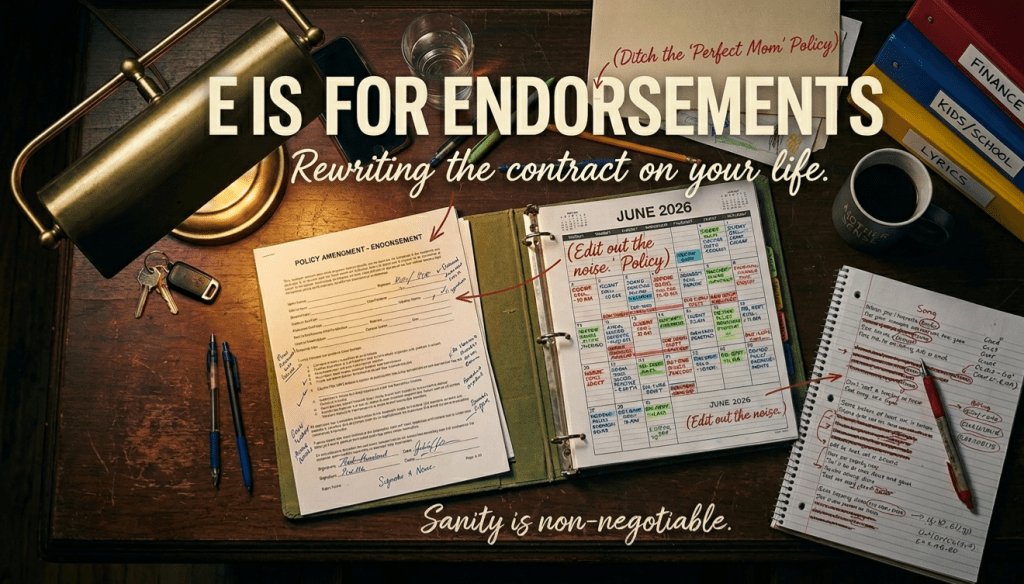
E is for Endorsements: Rewriting the Policy on Your Life


We are living our lives under an outdated policy.


When you first started building your world—whether you were launching a business, stepping into a creative project, mapping out a homeschool curriculum, or just figuring out how to manage a household—you wrote a mental contract. You set the terms and conditions for what you owed the world, what you were capable of producing, and how much of yourself you were willing to give away.
You signed it on the dotted line.
But life changes. The assets grow. The liabilities increase. The chaos of everyday life gets heavier, and yet, we find ourselves trying to fulfill a contract written for an entirely different season.


This is where the trap of efficiency kicks in. When we realize we can’t keep up with the terms of our own life policy, we don’t change the contract. Instead, we try to optimize the production line. We buy the color-coded binders. We look for the ultimate life hacks. We schedule our days down to the micro-second, trying to force a tired human soul to run with the efficiency of a corporate spreadsheet.
We treat ourselves like a machine that just needs better tuning. But you cannot efficiency-model your way out of a life that is simply carrying too much weight.


When efficiency fails, we have to turn to the writer’s desk and learn the brutal art of the creative edit. In songwriting and prose, editing is where the magic actually happens. It’s the willingness to take out the red pen, look at a line you love, and cut it because it’s crowding the melody. In life, editing means looking at a crowded calendar of good ideas—the projects, the to-do lists, the expectations—and realizing you have to cross things out so the main story can breathe.


But how do we actually authorize those cuts legally and emotionally within ourselves?
We use an endorsement.


In the insurance world, an endorsement is a specific amendment attached to an existing policy. It changes the terms. It updates the coverage. It acknowledges that the original agreement no longer fits the current risk or reality. It allows the policy to shift without tearing down the entire house.


As mothers, creators, and business owners, we forget that we are the sole underwriters of our own lives. We have the authority to file an endorsement at any given moment.
You are allowed to look at your current season and say, “The old policy required me to be everything to everyone at all times. This new amendment states that my peace is now a non-negotiable excluded risk. I am no longer insuring other people’s comfort at the expense of my own sanity.”


Stop trying to become more efficient at carrying a load that was never meant for one person. Take out the red pen and edit the narrative. File the endorsement, change the terms of what you owe the world, and rewrite the policy so you can actually live a life well-covered.

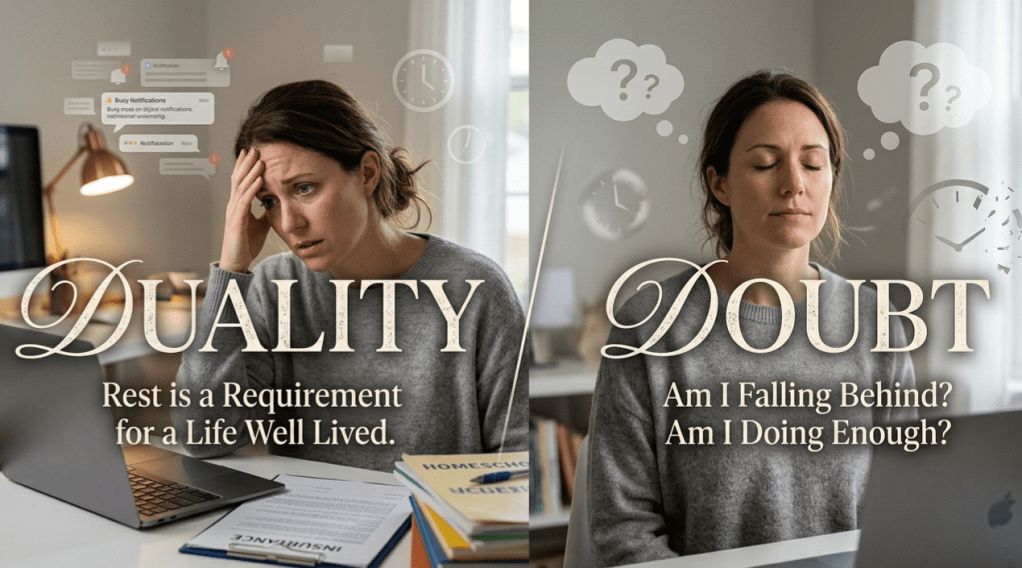
D is for Duality & Doubt: The Monday Morning Backlash


Last week, we waded through the thick of the chaos. We stood face-to-face with the friction of the empty space—that deeply uncomfortable territory where we intentionally stop rushing, clear out the noise, and force ourselves to just sit with the quiet.


If you tried to hold that empty space over the weekend, you know exactly how brutal it is. I personally kept my laptop closed and worked on some things around the house, cleaning, rearranging, and spent some time with my husband. I baked a chocolate cake Sunday afternoon that didn’t quite turn out how I had hoped. But it was a learning experience.


And as the laptop lid lifts open this Monday morning, a brand-new monster is waiting for us.
Welcome to Duality and Doubt.


Once you choose to clear out the chaos, your brain doesn’t just automatically hand you a crown of peace. Instead, a massive internal friction sets in. We find ourselves living a double life inside our own heads.
One version of you—the wise, grounded version—knows deep in your bones that protecting your space is a matter of survival. But the other version, the one conditioned by a world that demands a constant production line, stands over you whispering that your stillness is a failure.


The moment the weekly schedule kicks into gear, these two versions collide, bringing a swift, heavy wave of doubt.
You open the inbox, you look at the tasks ahead—the insurance training and compliance updates, the lesson plans to map out, the physical home to maintain—and the second-guessing begins. Did I lose ground by slowing down? Am I already behind? Did I actually earn the right to breathe?


We are so hooked on constant motion that when we finally create an empty space, we treat it like a crime we have to pay for on Monday morning. We feel the urge to sprint out of the gate at a million miles an hour, frantically overcompensating just to prove we are still worthy.


But true reclamation isn’t about clearing the chaos on Friday just to drown in the doubt on Monday.
The duality we have to master this week is learning how to hold onto our internal stillness while we do the work. It is knowing you can be deeply productive without being frantic.


As you step into the demands of this week, don’t let the Monday morning backlash trick you into running a race you weren’t meant to run. The work will always be there, but your peace belongs to you. Pace yourself today.

Did the doubt hit you the second you opened your screen this morning? How is your brain trying to make you pay for the empty space you kept this weekend?

C is for Chaos (and the Logic of Room to Move)

We’ve all done it.
On Sunday night, you sit down with a clean planner, a fresh Sharpie, and a vision. You map out the week with mathematical precision: Monday is carrier underwriting paperwork and high school biology modules; Tuesday is client check-ins and baking routines; Wednesday is a deep dive into catalog management. Every hour has a purpose. Every plate is spinning beautifully.
And then Monday morning happens.
A kid wakes up sick. A critical software system crashes. An unexpected, urgent contract update drops into your inbox, demanding immediate attention. Within two hours, your perfect schedule isn’t just slightly off track—it is completely atomized.
Welcome to the territory of Chaos.
When you are managing an independent business, coordinating a homeschool curriculum, and running a large household under one roof, chaos isn’t a rare visitor. It’s a permanent neighbor.
The real problem isn’t that chaos exists. The problem is how we build our lives to handle it. Most of us build our schedules like a high-stakes puzzle, packing every single piece so tightly against the next that there isn’t a single millimeter of space left over. We think that’s efficiency.
But in the real world, a system with zero space isn’t efficient—it’s fragile. The moment one piece shifts, the whole structure shatters, leaving you standing in the wreckage of your day, wrestling with anxiety, and feeling like you failed.
The Shift: The Logic of Margin
If we want to survive the unpredictable rhythms of a busy life, we have to stop building rigid structures. We need to start building systems with margin.
Think about the way an engineer builds a bridge or a developer writes code for an app. They don’t design it to only handle the absolute best-case scenario. They build in a buffer. They calculate the maximum load and then add extra tolerance for the unexpected heavy winds, the sudden surges, and the system shocks.
They build room to move.
Margin isn’t empty space; it’s functional space. It is the protective boundary that keeps a bad day from turning into a burned-out week.
The Antidote: Creating Your “Chaos Logic”
You can’t control when the unexpected will happen, but you can control how your day reacts to it. Here is how you build chaos logic into your actual, everyday schedule:
The 80% Rule: Never schedule your day to 100% capacity. If you have five usable hours in your work-and-school sandbox, only plan for four. Leave that final hour completely blank on purpose. If the day goes perfectly, congrats—you have an hour to get ahead or rest. If chaos strikes, that hour is your shock absorber.
Define Your “Tier-One” Non-Negotiables: When the day completely blows up, you cannot do it all. Period. You need a mental triage system. Look at your massive list and pick exactly two things that absolutely must happen today to keep the ship moving forward—one for the business, one for the family. Everything else gets automatically bumped to tomorrow without guilt.
Build a “Pivot Protocol”: When the schedule breaks, don’t waste energy frustrating yourself over the broken plan. Accept the pivot immediately. If the internet goes down and you can’t run quotes or submit licensing paperwork, close the screen and pivot entirely to an analog task—do a hands-on history lesson with your son, fold the laundry, or step outside. Work with the friction instead of fighting it.
Chaos wants to convince you that because your plan broke, you are out of control. It wants you to panic, drop your boundaries, and run yourself ragged trying to catch up.
Don’t buy into it.
The strength of your structure isn’t measured by how perfectly you stick to the script; it’s measured by how gracefully you can adapt when life goes off-script. Write your plans in pencil, build a little extra room into your day, and give yourself permission to navigate the chaos one pivot at a time.