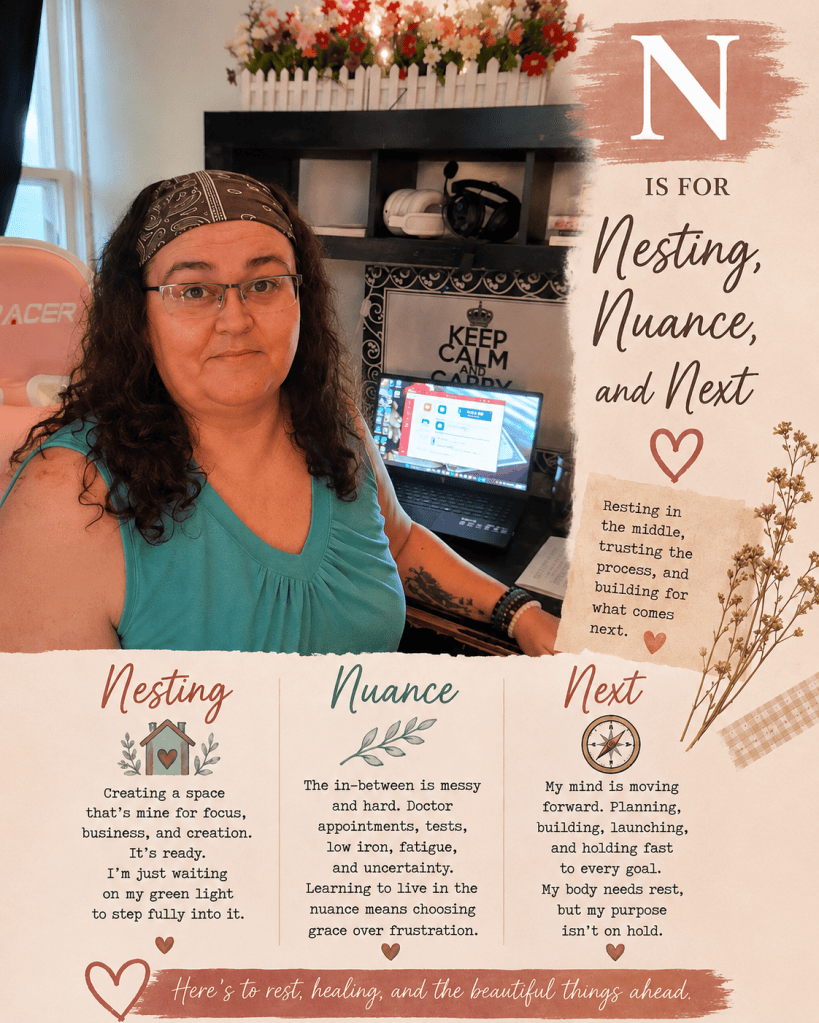
If there is one thing this season is teaching me, it’s that life rarely moves in a clean, straight line. Most days, it feels like holding three completely different realities in my hands at once: the physical space I’m trying to create, the uncertain middle ground of my health, and the big, bright future I refuse to let go of. Right now, three words are keeping me grounded: Nesting, Nuance, and Next. Nesting I’ve been quietly prepping a new office space in our guest bedroom—a little corner that is entirely mine, designated for focus, business, and creation. But for now, that room sits waiting. I’m waiting, too—specifically on the doctor’s green light to resume more strenuous activity. It’s a test of patience to see a space ready for you while your body demands that you sit still a little longer. Nuance Then there is the nuance of it all. Navigating endless doctor appointments, blood tests, heavy bleeding, low iron, and fatigue isn’t just exhausting; it forces you to face real questions about long-term health and your heart. There isn’t always a quick fix or a simple explanation. Learning to live in the nuance means acknowledging that I am tired and frustrated while still trusting that healing takes time. Next Despite the physical pause, my mind is moving forward. Next is where my hope lives. It’s planning for a good outcome, taking concrete steps to launch my insurance business, structuring the LLC for my publishing company, and holding fast to every single goal on my horizon. My body might need rest, but my purpose isn’t on hold. Here’s to resting in the middle, trusting the process, and building for what comes next.
Today marks a fresh page in the notebook. If you caught my post Saturday August 1, on A New Beginning, you know we are stepping into this season with fresh intention, a clean slate, and a willingness to embrace where we are right now. As we keep moving through our alphabetical journey, we’ve arrived at L. And honestly? It couldn’t have come at a better time. Life isn’t linear—it’s full of turns, unexpected shifts, and quiet victories. Today, we’re unpacking three “L” words that help us make sense of the journey and keep us grounded as we build what’s next. 1. Lessons (The Gold in the Grit) Every season leaves behind a trail of wisdom—if we’re willing to look for it. The hard days, the messy kitchen tables, the pivots in our plans, and the unexpected delays aren’t waste; they are curriculum. When we look back on where we’ve been, the goal isn’t to linger on what went wrong, but to gather up the lessons. What did that challenging week teach you about your boundaries? What did that creative block teach you about rest? When you view every outcome as information rather than failure, suddenly nothing is lost. Everything becomes fuel for where you’re going next. Takeaway: Don’t regret the detours. Write down the lesson, keep the wisdom, and drop the weight. 2. Layers (Embracing Your Multitudes) None of us are just one thing. You aren’t just defined by your day job, your family role, your creative side projects, or your past. You are a collection of layers built over time. Sometimes we feel pulled in a dozen directions because we carry so many different passions and responsibilities. But here’s the beauty of layers: they give you depth. The patience you practice in one area of your life feeds into your creative work. The organizational systems you build for your home give you the freedom to dream bigger. Embrace all the different titles and talents you carry—they don’t make you scattered; they make you whole. Takeaway: You don’t have to fit into a single box. Give yourself permission to honor every layer of who you are today. 3. Letting Go (Making Room for the New) You can’t start a new chapter if you’re still holding onto the clutter of the last one. Whether it’s physical space, old expectations, or the pressure to have everything figured out by Monday morning, letting go is the ultimate act of trust. As we launch into this new season, take a look around your desk, your calendar, and your mind. What are you holding onto simply out of habit? What mental tabs can you close today? When you clear out what isn’t serving your current season, you create the quiet space needed for new ideas, new energy, and new peace to settle in. Takeaway: Hands that are full of old clutter can’t reach for new blessings. Open your hands and let it go. Bringing It Home Today As you move through this weekend, take a quiet moment over your morning coffee or evening wind-down to ask yourself: What lesson am I carrying forward into this new start? What layer of myself have I been neglecting lately? What space do I need to clear out to make room for what’s next? Here’s to living intentionally, learning as we go, and giving ourselves grace for the journey.
The calendar tells us that Friday, June 19th is Juneteenth—a day designated for collective reflection, freedom, and celebration. But for me, the date always pulls me backward into a deeply personal history. It forces a quiet pause in the middle of summer. It rewinds the clock to 2019, to a road trip to Louisiana, and to a room filled with a heavy, holy kind of love. June 19th was my precious Uncle John’s birthday. For probably twenty years or more, if you asked him his age, he’d grin and tell you he was “39 and holding.” But on that specific Wednesday in 2019, time was finally catching up. My sisters and I traveled down to see him, knowing we were stepping into a celebration that was also a final, fragile goodbye. He was about to be transitioned to comfort care. The air in the room was heavy. We each took a turn to have a moment alone with him. When my turn came, I leaned in close. I leaned into the space between this world and whatever comes next, and I whispered into his ear that it was okay to go. I told him that Jeff would take care of me now. I’m not entirely sure how aware he was in that moment, but whispering those words into the quiet of the room was a balm for my own aching heart. Then, the priest arrived to perform the anointing of the sick. Because Uncle John was a deacon, he shared a long, deeply rooted history with the priest—a brotherhood of faith and service. Yet, in the middle of all that sorrow, a strange and beautiful thing happened. The priest looked at me, knew exactly who I was, and called me by my name. “Emeline’s daughter,” he recognized. Uncle John had woven stories of me into his life and friendships long before those final days. He had carried me in his conversations for years, just as he carried me in his heart. I still sit with that moment. I think about it every June 19th, right before the anniversary of his passing on June 20th. I look up at the sky and whisper back to him, hoping with everything I have that I am making him proud. The Magic of a Louisiana Kitchen When the grief settles into something softer, it usually leads me straight to the stove. Truthfully, I was blessed with a family of cooks. Uncle John and Aunt Mertie weren’t the only ones who let me sit and pepper them with a million questions while they worked. But being in those Louisiana kitchens? That was a different kind of magic entirely. Growing up, learning from Mom or Granny had its own rhythm, rooted in the familiar comfort of daily life. But stepping into Uncle John and Aunt Mertie’s kitchen felt like entering a sacred, vibrant sanctuary of flavor and storytelling. The humidity, the slow simmer of a roux, the effortless dance between them as they threw together dishes that tasted like pure love—it was an education in hospitality. They didn’t do it through formal lessons; they taught me simply by letting me exist in their space, answering every curious question a young girl could dream up. To pass down a legacy is to answer the questions of the curious girl standing by the counter, watching you create. God, I miss them. I miss the laughter, the Louisiana warmth, and the safe harbor of their home. But every time I replicate a flavor, test the seasoning, or cook with that patient, soul-filled instinct they modeled for me, they are right there. So this Friday, while the world celebrates, I’ll be holding a quiet space for the deacon who was forever 39, for the mother who came before me, and for the beautiful, heartbreaking privilege of having people in our lives who are this terribly hard to lose. Happy Birthday, Uncle Johnny. I hope the kitchen in heaven is everything you ever wanted.
We talk a lot about building margin. We map out the curriculum, we lock down the client boundaries, and we declare that we are finally carving out “room to move.” It sounds beautiful on paper. It looks incredibly efficient in a planner. But nobody warns you about the immediate, jarring friction that happens the second you actually succeed in creating that empty space. When the chaos clears—even for an hour—the silence isn’t instantly peaceful. It’s loud. It’s uncomfortable. Your brain, completely addicted to the high-voltage hum of constant multitasking, immediately starts to panic. It interprets the quiet as a crisis. The internal narrative kicks in like clockwork: You’re forgetting something. You should be checking the inbox. You should be prepping the next module. You are falling behind. That is the friction of the empty space. It is the exact moment the myth of “balance” tries to pull you back into the blur. True counter-balancing means sitting right in the middle of that discomfort without rushing to fill it. It means recognizing that the urge to frantically check a screen or pick up another task isn’t a sign of productivity—it’s just the muscle memory of burnout trying to take over again. The empty space feels heavy because we aren’t used to carrying our own presence without a digital buffer. But margin isn’t a vacuum to be filled; it is the oxygen your creativity and your household actually need to survive. This weekend, when the space opens up and the panic whispers that you should be doing more, let it whisper. Sit through the friction. The quiet is where the real recovery begins.
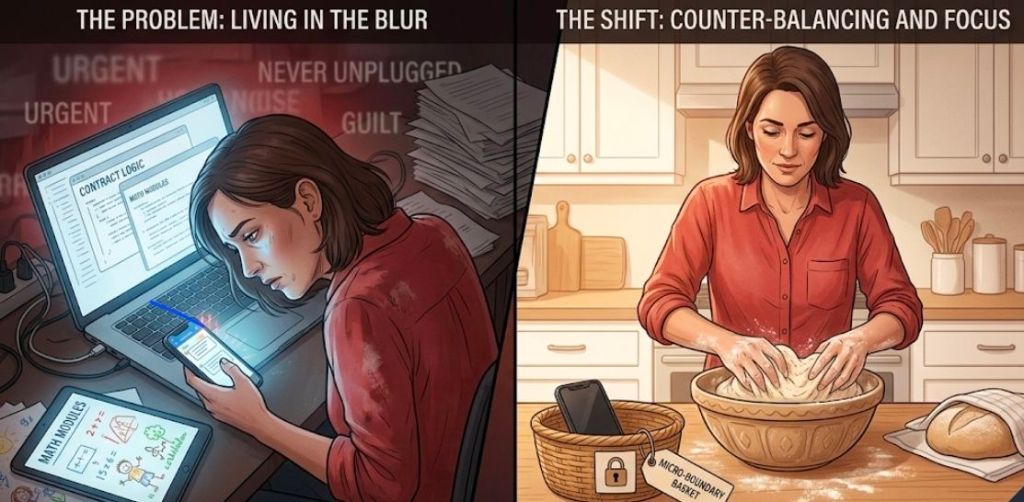
If A is for the quiet, internal engine of Anxiety, then B is the inevitable smoke that pours out from under the hood when that engine runs hot for too long. It’s called Burnout. If you are trying to manage a career, navigate a changing professional landscape, educate your kids at home, keep a kitchen running, and maintain your sanity, you know exactly what the onset of burnout feels like. It’s not just being tired. It’s the feeling that your battery is no longer holding a charge. We are told the antidote to this exhaustion is “balance.” We see the images of the perfectly balanced life—the pristine calendar, the meal-prepped containers, the seamless transition from business calls to school lessons without a hair out of place. But let’s be honest: Balance is a cultural lie. And chasing it is making us sick. The Problem: Living in the Blur The real culprit behind burnout isn’t that we have too much to do. It’s that we have too much to do in the exact same space. When your dining room table is simultaneously an underwriting desk, a classroom, a family board game hub, and a bakery, the lines don’t just blur—they vanish entirely. You find yourself reading a carrier contract while checking math homework. You look at a text message from a client while trying to listen to your teenager. Because your brain never gets a change of scenery, it never gets a cue to switch modes. You are always “on,” always producing, and always failing to meet the impossible standard of doing it all perfectly at the exact same time. That isn’t balance. It’s a recipe for a breakdown. The Shift: Trading Balance for Counter-Balancing If we want to stop the burn, we have to stop trying to keep every single plate spinning at the exact same height. It’s time to trade the myth of static balance for the reality of Counter-Balancing. Balance implies that everything gets equal weight, every single day. That is a fantasy. Counter-balancing means accepting that life moves in seasons, weeks, and even hours. Some days, the business demands 80% of your brain power, and the laundry pile is just going to have to sit there. That is not failure; that is focus. Some days, a child needs your undivided, uninterrupted presence, and the inbox has to wait. That is not falling behind; that is prioritizing. The moment you give yourself permission to lean heavily into one thing at a time—without the crushing weight of guilt about the things you are temporarily leaving behind—burnout loses its grip. The Antidote: Building Micro-Boundaries In my last post, we talked about fighting anxiety with the antidote of the next small step. We fight burnout the exact same way: with the antidote of the micro-boundary. If you can’t build physical walls between your different worlds right now, you have to build psychological ones. You don’t need a massive life overhaul; you just need small, non-negotiable anchors to signal to your brain that it is time to switch gears. The “Clock-Out” Ritual: Pick a time where the laptop closes and the business phone goes into a drawer or a basket in another room. The work will always be there tomorrow, but your family needs you present tonight. Analog Anchors: Use a physical, tactile activity to transition your brain out of production mode. For me, it’s the rhythm of kneading bread dough, stepping outside into the grass, or making a physical cup of tea. It’s something that forces your hands into the real world and pulls your mind out of the digital screen. One Sandbox at a Time: When you are homeschooling, be the teacher. When you are auditing a contract, be the business owner. Turn off notifications for the world you aren’t currently occupying. Burnout happens when we try to be everything to everyone, all at once, in the same square foot of space. Take a breath. Forgive yourself for the messy kitchen or the unanswered email. Choose the one thing that matters right now, lean into it with everything you’ve got, and let the rest of the world wait its turn.