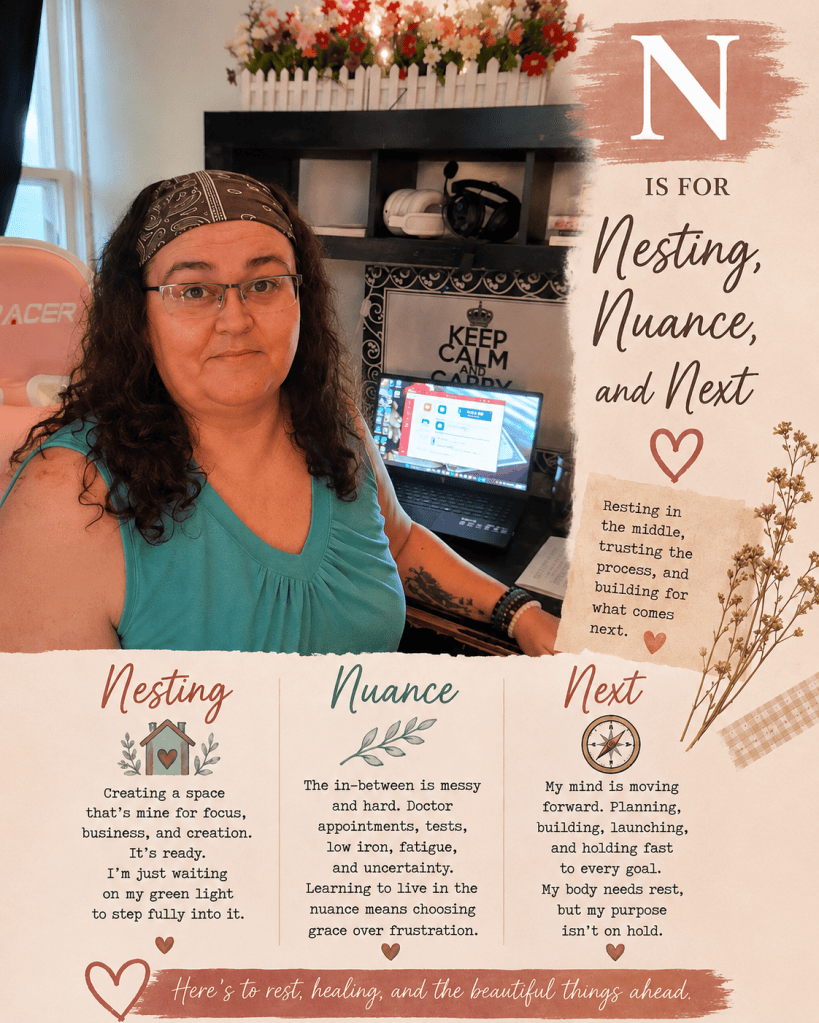
If there is one thing this season is teaching me, it’s that life rarely moves in a clean, straight line. Most days, it feels like holding three completely different realities in my hands at once: the physical space I’m trying to create, the uncertain middle ground of my health, and the big, bright future I refuse to let go of. Right now, three words are keeping me grounded: Nesting, Nuance, and Next. Nesting I’ve been quietly prepping a new office space in our guest bedroom—a little corner that is entirely mine, designated for focus, business, and creation. But for now, that room sits waiting. I’m waiting, too—specifically on the doctor’s green light to resume more strenuous activity. It’s a test of patience to see a space ready for you while your body demands that you sit still a little longer. Nuance Then there is the nuance of it all. Navigating endless doctor appointments, blood tests, heavy bleeding, low iron, and fatigue isn’t just exhausting; it forces you to face real questions about long-term health and your heart. There isn’t always a quick fix or a simple explanation. Learning to live in the nuance means acknowledging that I am tired and frustrated while still trusting that healing takes time. Next Despite the physical pause, my mind is moving forward. Next is where my hope lives. It’s planning for a good outcome, taking concrete steps to launch my insurance business, structuring the LLC for my publishing company, and holding fast to every single goal on my horizon. My body might need rest, but my purpose isn’t on hold. Here’s to resting in the middle, trusting the process, and building for what comes next.
We talk a lot about building margin. We map out the curriculum, we lock down the client boundaries, and we declare that we are finally carving out “room to move.” It sounds beautiful on paper. It looks incredibly efficient in a planner. But nobody warns you about the immediate, jarring friction that happens the second you actually succeed in creating that empty space. When the chaos clears—even for an hour—the silence isn’t instantly peaceful. It’s loud. It’s uncomfortable. Your brain, completely addicted to the high-voltage hum of constant multitasking, immediately starts to panic. It interprets the quiet as a crisis. The internal narrative kicks in like clockwork: You’re forgetting something. You should be checking the inbox. You should be prepping the next module. You are falling behind. That is the friction of the empty space. It is the exact moment the myth of “balance” tries to pull you back into the blur. True counter-balancing means sitting right in the middle of that discomfort without rushing to fill it. It means recognizing that the urge to frantically check a screen or pick up another task isn’t a sign of productivity—it’s just the muscle memory of burnout trying to take over again. The empty space feels heavy because we aren’t used to carrying our own presence without a digital buffer. But margin isn’t a vacuum to be filled; it is the oxygen your creativity and your household actually need to survive. This weekend, when the space opens up and the panic whispers that you should be doing more, let it whisper. Sit through the friction. The quiet is where the real recovery begins.
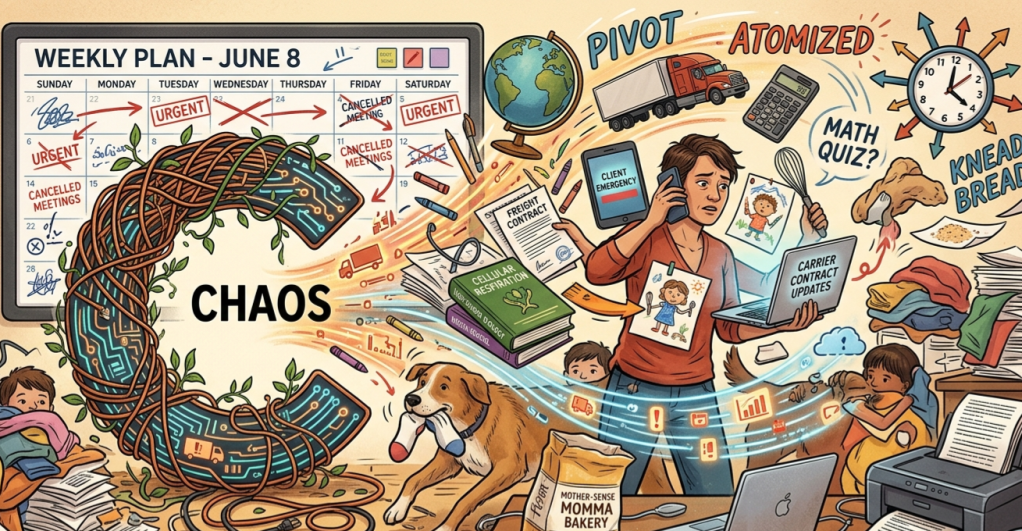
We’ve all done it. On Sunday night, you sit down with a clean planner, a fresh Sharpie, and a vision. You map out the week with mathematical precision: Monday is carrier underwriting paperwork and high school biology modules; Tuesday is client check-ins and baking routines; Wednesday is a deep dive into catalog management. Every hour has a purpose. Every plate is spinning beautifully. And then Monday morning happens. A kid wakes up sick. A critical software system crashes. An unexpected, urgent contract update drops into your inbox, demanding immediate attention. Within two hours, your perfect schedule isn’t just slightly off track—it is completely atomized. Welcome to the territory of Chaos. When you are managing an independent business, coordinating a homeschool curriculum, and running a large household under one roof, chaos isn’t a rare visitor. It’s a permanent neighbor. The real problem isn’t that chaos exists. The problem is how we build our lives to handle it. Most of us build our schedules like a high-stakes puzzle, packing every single piece so tightly against the next that there isn’t a single millimeter of space left over. We think that’s efficiency. But in the real world, a system with zero space isn’t efficient—it’s fragile. The moment one piece shifts, the whole structure shatters, leaving you standing in the wreckage of your day, wrestling with anxiety, and feeling like you failed. The Shift: The Logic of Margin If we want to survive the unpredictable rhythms of a busy life, we have to stop building rigid structures. We need to start building systems with margin. Think about the way an engineer builds a bridge or a developer writes code for an app. They don’t design it to only handle the absolute best-case scenario. They build in a buffer. They calculate the maximum load and then add extra tolerance for the unexpected heavy winds, the sudden surges, and the system shocks. They build room to move. Margin isn’t empty space; it’s functional space. It is the protective boundary that keeps a bad day from turning into a burned-out week. The Antidote: Creating Your “Chaos Logic” You can’t control when the unexpected will happen, but you can control how your day reacts to it. Here is how you build chaos logic into your actual, everyday schedule: The 80% Rule: Never schedule your day to 100% capacity. If you have five usable hours in your work-and-school sandbox, only plan for four. Leave that final hour completely blank on purpose. If the day goes perfectly, congrats—you have an hour to get ahead or rest. If chaos strikes, that hour is your shock absorber. Define Your “Tier-One” Non-Negotiables: When the day completely blows up, you cannot do it all. Period. You need a mental triage system. Look at your massive list and pick exactly two things that absolutely must happen today to keep the ship moving forward—one for the business, one for the family. Everything else gets automatically bumped to tomorrow without guilt. Build a “Pivot Protocol”: When the schedule breaks, don’t waste energy frustrating yourself over the broken plan. Accept the pivot immediately. If the internet goes down and you can’t run quotes or submit licensing paperwork, close the screen and pivot entirely to an analog task—do a hands-on history lesson with your son, fold the laundry, or step outside. Work with the friction instead of fighting it. Chaos wants to convince you that because your plan broke, you are out of control. It wants you to panic, drop your boundaries, and run yourself ragged trying to catch up. Don’t buy into it. The strength of your structure isn’t measured by how perfectly you stick to the script; it’s measured by how gracefully you can adapt when life goes off-script. Write your plans in pencil, build a little extra room into your day, and give yourself permission to navigate the chaos one pivot at a time.
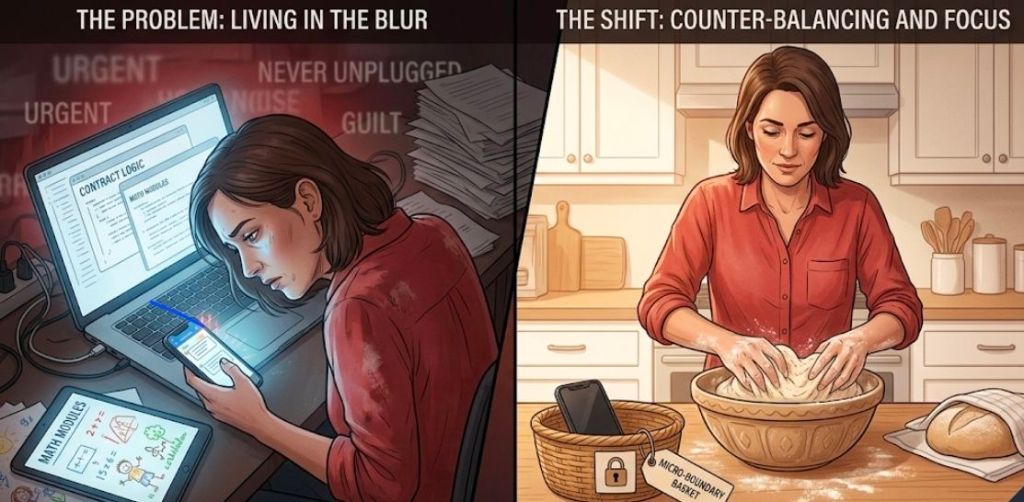
If A is for the quiet, internal engine of Anxiety, then B is the inevitable smoke that pours out from under the hood when that engine runs hot for too long. It’s called Burnout. If you are trying to manage a career, navigate a changing professional landscape, educate your kids at home, keep a kitchen running, and maintain your sanity, you know exactly what the onset of burnout feels like. It’s not just being tired. It’s the feeling that your battery is no longer holding a charge. We are told the antidote to this exhaustion is “balance.” We see the images of the perfectly balanced life—the pristine calendar, the meal-prepped containers, the seamless transition from business calls to school lessons without a hair out of place. But let’s be honest: Balance is a cultural lie. And chasing it is making us sick. The Problem: Living in the Blur The real culprit behind burnout isn’t that we have too much to do. It’s that we have too much to do in the exact same space. When your dining room table is simultaneously an underwriting desk, a classroom, a family board game hub, and a bakery, the lines don’t just blur—they vanish entirely. You find yourself reading a carrier contract while checking math homework. You look at a text message from a client while trying to listen to your teenager. Because your brain never gets a change of scenery, it never gets a cue to switch modes. You are always “on,” always producing, and always failing to meet the impossible standard of doing it all perfectly at the exact same time. That isn’t balance. It’s a recipe for a breakdown. The Shift: Trading Balance for Counter-Balancing If we want to stop the burn, we have to stop trying to keep every single plate spinning at the exact same height. It’s time to trade the myth of static balance for the reality of Counter-Balancing. Balance implies that everything gets equal weight, every single day. That is a fantasy. Counter-balancing means accepting that life moves in seasons, weeks, and even hours. Some days, the business demands 80% of your brain power, and the laundry pile is just going to have to sit there. That is not failure; that is focus. Some days, a child needs your undivided, uninterrupted presence, and the inbox has to wait. That is not falling behind; that is prioritizing. The moment you give yourself permission to lean heavily into one thing at a time—without the crushing weight of guilt about the things you are temporarily leaving behind—burnout loses its grip. The Antidote: Building Micro-Boundaries In my last post, we talked about fighting anxiety with the antidote of the next small step. We fight burnout the exact same way: with the antidote of the micro-boundary. If you can’t build physical walls between your different worlds right now, you have to build psychological ones. You don’t need a massive life overhaul; you just need small, non-negotiable anchors to signal to your brain that it is time to switch gears. The “Clock-Out” Ritual: Pick a time where the laptop closes and the business phone goes into a drawer or a basket in another room. The work will always be there tomorrow, but your family needs you present tonight. Analog Anchors: Use a physical, tactile activity to transition your brain out of production mode. For me, it’s the rhythm of kneading bread dough, stepping outside into the grass, or making a physical cup of tea. It’s something that forces your hands into the real world and pulls your mind out of the digital screen. One Sandbox at a Time: When you are homeschooling, be the teacher. When you are auditing a contract, be the business owner. Turn off notifications for the world you aren’t currently occupying. Burnout happens when we try to be everything to everyone, all at once, in the same square foot of space. Take a breath. Forgive yourself for the messy kitchen or the unanswered email. Choose the one thing that matters right now, lean into it with everything you’ve got, and let the rest of the world wait its turn.
On Monday, we talked about the mental health ABCs—the tools, the structure, the visible strategies. But if we are honest, sometimes you practice the steps, you do the work, and… nothing seems to change. The surface of your life still looks just as dry, cracked, or foggy as it did before. It’s easy to feel like you’re failing when you don’t see immediate results. But real growth doesn’t start in the sun. It starts in the dark. Think about a seed. When it’s buried in the dirt, there are no leaves yet. There are no fruits, no deep roots, no visible proof of life. To anyone looking from the outside, it looks like a whole lot of nothing. But underneath the surface, that seed is active. It’s germinating, shifting, and doing exactly what it needs to do to build a foundation. It is preparing to break through. Every flower blooms on its own timeline, and every human is a unique, imperfectly perfect creation. We can’t force the season, and we can’t copy someone else’s timeline. Country artist Eric Church recently spoke to a crowd of graduates and said something that cuts right to the heart of this. He told them that the world doesn’t need more cover songs—it needs your voice. It needs your unique perspective. Trying to rush your healing or mimic someone else’s visible success is just playing a cover song. Your growth is allowed to be quiet. It is allowed to take time. The unseen work you are doing right now to take care of your mind, to protect your peace, and to just hold on in the quiet—that matters. The seeds we plant in the dark will not grow overnight. But if you give them time, one day you will get to enjoy the beauty of the work that seed did before it ever even saw the light. Be patient with your timeline this weekend. You are still growing, even when it’s quiet.