
If A is for the quiet, internal engine of Anxiety, then B is the inevitable smoke that pours out from under the hood when that engine runs hot for too long.
It’s called Burnout.
If you are trying to manage a career, navigate a changing professional landscape, educate your kids at home, keep a kitchen running, and maintain your sanity, you know exactly what the onset of burnout feels like. It’s not just being tired. It’s the feeling that your battery is no longer holding a charge.
We are told the antidote to this exhaustion is “balance.” We see the images of the perfectly balanced life—the pristine calendar, the meal-prepped containers, the seamless transition from business calls to school lessons without a hair out of place.
But let’s be honest: Balance is a cultural lie. And chasing it is making us sick.
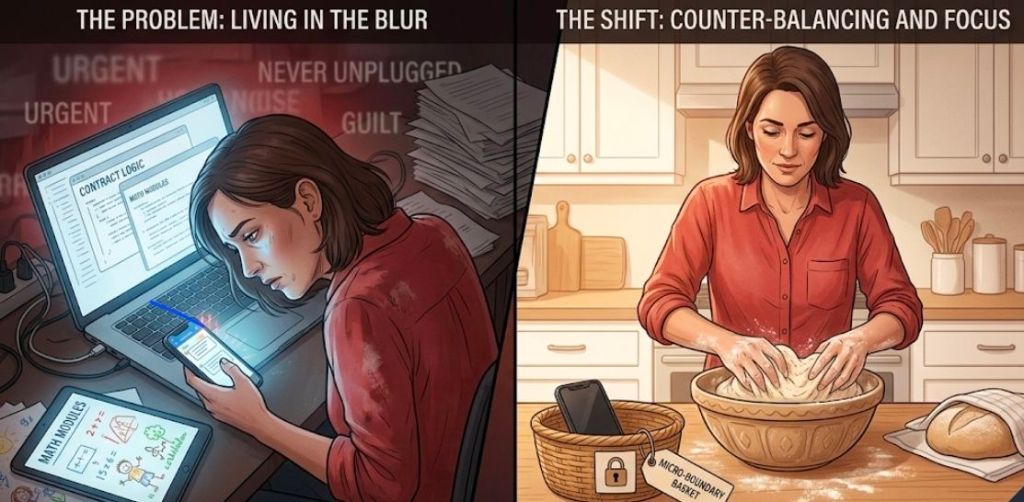
The Problem: Living in the Blur
The real culprit behind burnout isn’t that we have too much to do. It’s that we have too much to do in the exact same space.
When your dining room table is simultaneously an underwriting desk, a classroom, a family board game hub, and a bakery, the lines don’t just blur—they vanish entirely. You find yourself reading a carrier contract while checking math homework. You look at a text message from a client while trying to listen to your teenager.
Because your brain never gets a change of scenery, it never gets a cue to switch modes. You are always “on,” always producing, and always failing to meet the impossible standard of doing it all perfectly at the exact same time.
That isn’t balance. It’s a recipe for a breakdown.
The Shift: Trading Balance for Counter-Balancing
If we want to stop the burn, we have to stop trying to keep every single plate spinning at the exact same height. It’s time to trade the myth of static balance for the reality of Counter-Balancing.
Balance implies that everything gets equal weight, every single day. That is a fantasy. Counter-balancing means accepting that life moves in seasons, weeks, and even hours.
Some days, the business demands 80% of your brain power, and the laundry pile is just going to have to sit there. That is not failure; that is focus.
Some days, a child needs your undivided, uninterrupted presence, and the inbox has to wait. That is not falling behind; that is prioritizing.
The moment you give yourself permission to lean heavily into one thing at a time—without the crushing weight of guilt about the things you are temporarily leaving behind—burnout loses its grip.
The Antidote: Building Micro-Boundaries
In my last post, we talked about fighting anxiety with the antidote of the next small step. We fight burnout the exact same way: with the antidote of the micro-boundary.
If you can’t build physical walls between your different worlds right now, you have to build psychological ones. You don’t need a massive life overhaul; you just need small, non-negotiable anchors to signal to your brain that it is time to switch gears.
The “Clock-Out” Ritual: Pick a time where the laptop closes and the business phone goes into a drawer or a basket in another room. The work will always be there tomorrow, but your family needs you present tonight.
Analog Anchors: Use a physical, tactile activity to transition your brain out of production mode. For me, it’s the rhythm of kneading bread dough, stepping outside into the grass, or making a physical cup of tea. It’s something that forces your hands into the real world and pulls your mind out of the digital screen.
One Sandbox at a Time: When you are homeschooling, be the teacher. When you are auditing a contract, be the business owner. Turn off notifications for the world you aren’t currently occupying.
Burnout happens when we try to be everything to everyone, all at once, in the same square foot of space.
Take a breath. Forgive yourself for the messy kitchen or the unanswered email. Choose the one thing that matters right now, lean into it with everything you’ve got, and let the rest of the world wait its turn.

