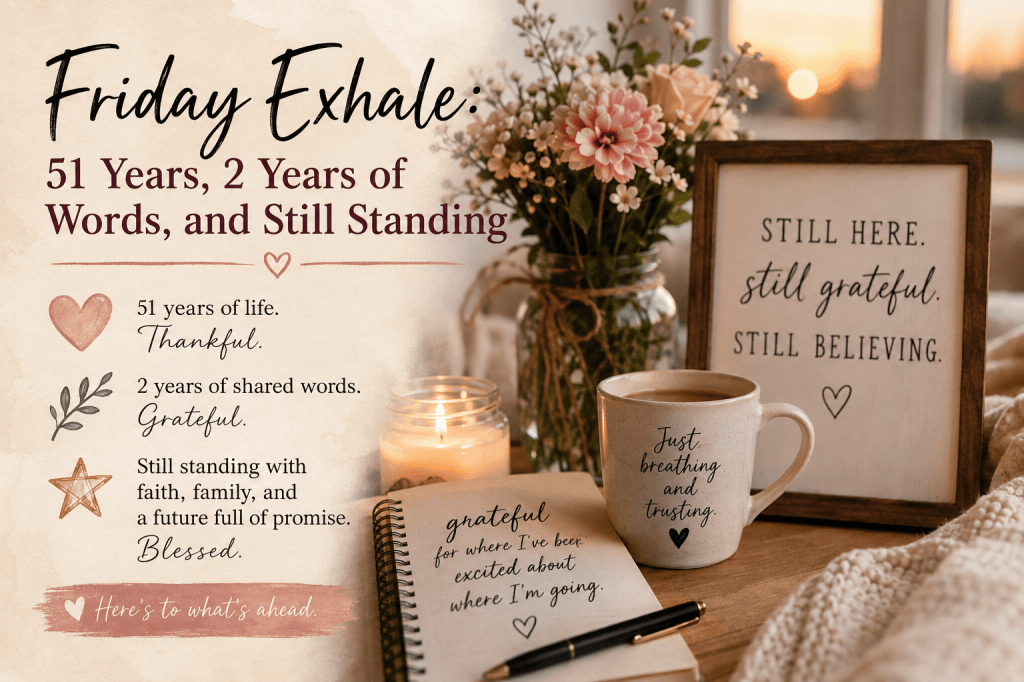
Whew. Take a deep breath with me. This week brings a quiet moment of reflection as I celebrate my 51st birthday—and mark almost two full years of sharing my heart on this blog. Looking back over where I’ve been and where I am standing today, only one phrase truly fits: I am still here. Making it to 51 is an incredible, humbling blessing. Life hasn’t been a smooth, polished path; it has been full of real, sharp highs and deep, heavy lows. But sitting here on the other side of those seasons, my heart is overflowing with gratitude. I look at my life and see a landscape rich with love. I am blessed with a wonderful, supportive husband who stands beside me, incredible children who make me proud every single day, and precious grandchildren who bring endless joy to my world. On top of that, I’m standing on the threshold of exciting new business opportunities, watching hard work turn into real progress. Through every trial, health scare, and triumph, my family and my faith have been the anchor. So as this week comes to a close, I’m stepping into the weekend not focused on the weariness of the journey, but on the joy of the destination. Here’s to 51 years of life, two years of shared words, and a future full of promise. Thankful. Grateful. Blessed.
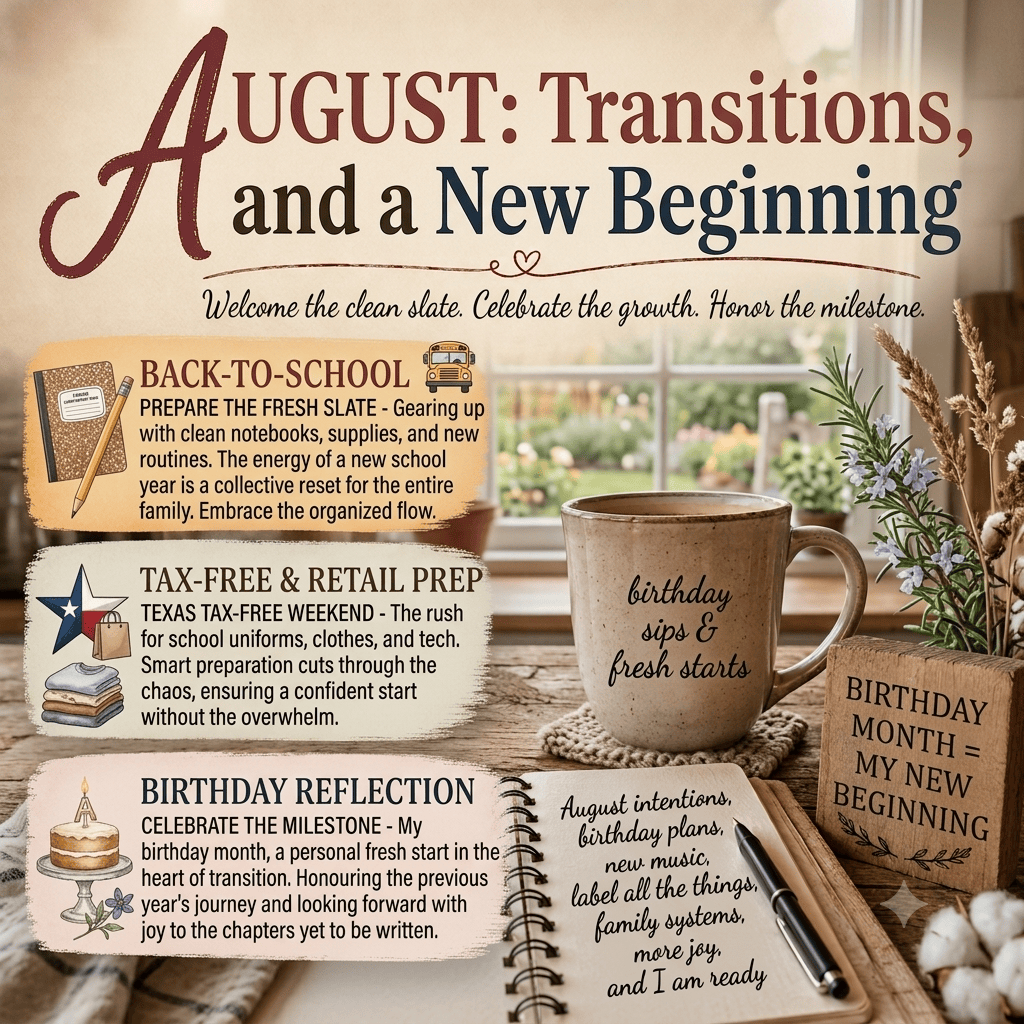
Welcome to August. There is a shift in the air today, a distinct change in the season’s rhythm. For many, August marks the ultimate month of transitions. Around here, everyone is gearing up for the whirlwind of back-to-school season. Parents are checking off school supply lists, preparing for the upcoming Texas tax-free weekend, mapping out trips to Back-to-School Fairs, and rushing around for sports physicals. The entire community is collectively leaning into the preparation for a brand-new school year. It is a season defined by clean slates, fresh notebooks, and new beginnings. But for me, August brings a completely different layer of celebration and reflection: it is officially the beginning of my birthday month! Turning a year older right alongside this collective community reset feels incredibly fitting. As a former classroom teacher, the energy of a new school year is practically woven into my DNA. Even though my daily schedule looks different now, that “new notebook” feeling never truly leaves you. It’s a reminder that no matter what kind of physical limitations, pauses, or unexpected health hurdles the previous months have thrown our way, August arrives with an invitation to start fresh. A birthday month in a season of transition is the perfect excuse to evaluate where we are going and how we want to get there. It’s a time to celebrate another trip around the sun, to honor the roots that keep us steady, and to confidently look forward to the chapters yet to be written. Whether you are frantically labeling school supplies, adjusting to a new family schedule, or celebrating a personal milestone of your own this month, let’s embrace the transition. Let’s welcome the new beginnings, the fresh energy, and a month dedicated to celebrating growth. Happy August, everyone. Let’s make it a beautiful one.
We are hitting the release valve again today. No alphabet lessons, no self-improvement frameworks, and absolutely no expectations. Just a deep, collective breath heading into the weekend. I’m calling today the Friday Freedom Exhale. When you are someone who is used to operating at full capacity, the hardest part of navigating a forced health pause or carrying heavy grief isn’t just the physical limitation—it’s the mental trap. We tell ourselves that if we aren’t working on our big, full-steam-ahead plans, then we must be strictly resting. We turn rest into a chore, a rigid box we have to stay inside of so we can heal. But true freedom doesn’t live in a rigid box. So today, consider this your official, unfiltered permission slip to do exactly what your spirit needs this weekend—whether that means doing all the things or absolutely nothing at all. If your body is finally feeling a spark of energy and you want to bake a mess of bread, dive into a creative project, or deep-clean the kitchen because that is what puts your mind in order—do it. Do all of it with joy, and don’t feel guilty for “wasting” your resting energy. And if your body or your heart looks at the weekend and says, “I cannot move,” then let the dishes pile up. Leave the projects right where they are. Lie on the couch, turn on a favorite crime drama, and do completely, beautifully nothing. Freedom is knowing that you don’t owe anyone a predictable pace. You are allowed to ride the waves of your own capacity. You can be a force of nature on Saturday and completely still on Sunday. Drop your shoulders. Unclench your jaw. The weekend is here, and the choice is entirely yours. Let’s exhale.
We’ve all done it. On Sunday night, you sit down with a clean planner, a fresh Sharpie, and a vision. You map out the week with mathematical precision: Monday is carrier underwriting paperwork and high school biology modules; Tuesday is client check-ins and baking routines; Wednesday is a deep dive into catalog management. Every hour has a purpose. Every plate is spinning beautifully. And then Monday morning happens. A kid wakes up sick. A critical software system crashes. An unexpected, urgent contract update drops into your inbox, demanding immediate attention. Within two hours, your perfect schedule isn’t just slightly off track—it is completely atomized. Welcome to the territory of Chaos. When you are managing an independent business, coordinating a homeschool curriculum, and running a large household under one roof, chaos isn’t a rare visitor. It’s a permanent neighbor. The real problem isn’t that chaos exists. The problem is how we build our lives to handle it. Most of us build our schedules like a high-stakes puzzle, packing every single piece so tightly against the next that there isn’t a single millimeter of space left over. We think that’s efficiency. But in the real world, a system with zero space isn’t efficient—it’s fragile. The moment one piece shifts, the whole structure shatters, leaving you standing in the wreckage of your day, wrestling with anxiety, and feeling like you failed. The Shift: The Logic of Margin If we want to survive the unpredictable rhythms of a busy life, we have to stop building rigid structures. We need to start building systems with margin. Think about the way an engineer builds a bridge or a developer writes code for an app. They don’t design it to only handle the absolute best-case scenario. They build in a buffer. They calculate the maximum load and then add extra tolerance for the unexpected heavy winds, the sudden surges, and the system shocks. They build room to move. Margin isn’t empty space; it’s functional space. It is the protective boundary that keeps a bad day from turning into a burned-out week. The Antidote: Creating Your “Chaos Logic” You can’t control when the unexpected will happen, but you can control how your day reacts to it. Here is how you build chaos logic into your actual, everyday schedule: The 80% Rule: Never schedule your day to 100% capacity. If you have five usable hours in your work-and-school sandbox, only plan for four. Leave that final hour completely blank on purpose. If the day goes perfectly, congrats—you have an hour to get ahead or rest. If chaos strikes, that hour is your shock absorber. Define Your “Tier-One” Non-Negotiables: When the day completely blows up, you cannot do it all. Period. You need a mental triage system. Look at your massive list and pick exactly two things that absolutely must happen today to keep the ship moving forward—one for the business, one for the family. Everything else gets automatically bumped to tomorrow without guilt. Build a “Pivot Protocol”: When the schedule breaks, don’t waste energy frustrating yourself over the broken plan. Accept the pivot immediately. If the internet goes down and you can’t run quotes or submit licensing paperwork, close the screen and pivot entirely to an analog task—do a hands-on history lesson with your son, fold the laundry, or step outside. Work with the friction instead of fighting it. Chaos wants to convince you that because your plan broke, you are out of control. It wants you to panic, drop your boundaries, and run yourself ragged trying to catch up. Don’t buy into it. The strength of your structure isn’t measured by how perfectly you stick to the script; it’s measured by how gracefully you can adapt when life goes off-script. Write your plans in pencil, build a little extra room into your day, and give yourself permission to navigate the chaos one pivot at a time.
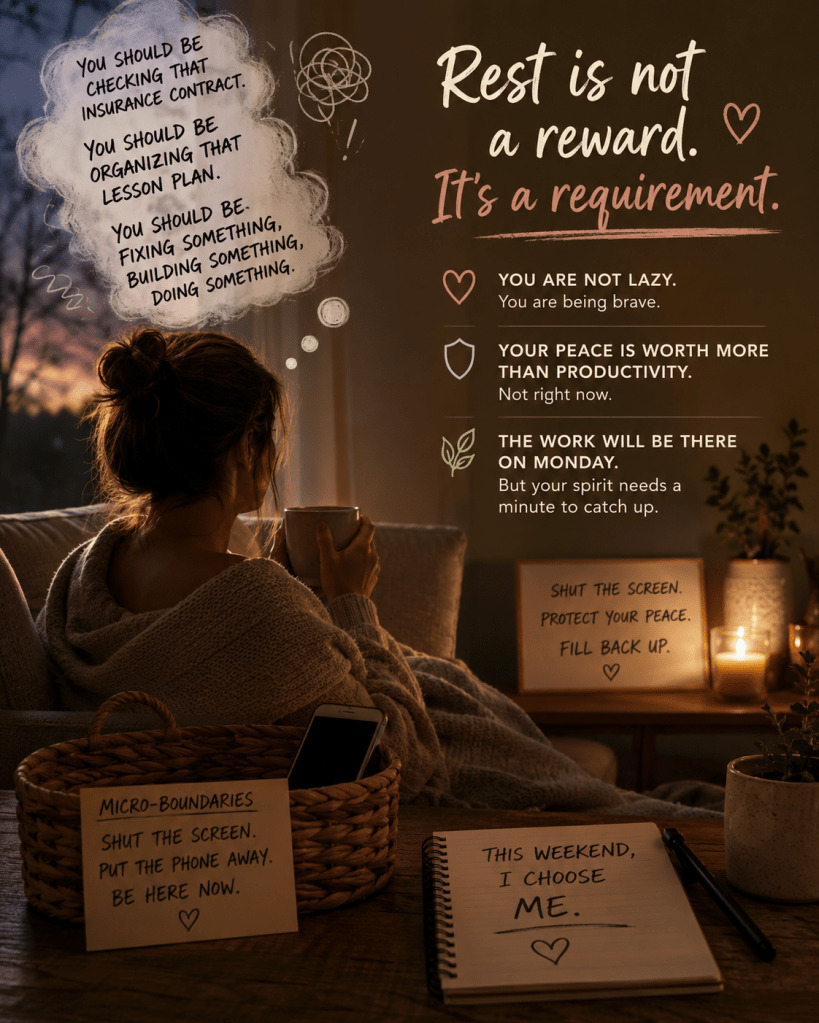
On Monday, we talked about the danger of the blur—that exhausting space where your work life, your home life, and your school day bleed together until you are running on empty. We talked about the antidote: building micro-boundaries, shutting the screen, and putting the phone in a basket. It sounds so good on paper. It feels like a victory when you actually do it. But if we are being completely honest, no one talks about what happens right after you shut the laptop or put the phone away. No one talks about the silence. And no one talks about how incredibly loud that silence can be. The moment you enforce a boundary and step away from the production line, a weird kind of panic can set in. You sit down on the couch, or you step into the kitchen, and instead of feeling a wave of peace, you feel a wave of guilt. Your brain, which has been conditioned to run at a million miles an hour, starts screaming at you: You should be checking that insurance contract. You should be organizing that lesson plan. You should be fixing something, building something, doing something. We live in a culture that treats constant motion as a badge of honor. We are conditioned to believe that if we aren’t producing, we are failing. So when we finally force ourselves to stop, the quiet doesn’t feel like a reward—it feels like an withdrawal. It is deeply uncomfortable to just sit still. But here is the truth we have to remind ourselves of as we head into the weekend: Rest is not a reward for a job well done. It is a requirement for a life well lived. When you choose to step away, you aren’t being lazy. You are being brave. It takes an incredible amount of courage to look at an endless to-do list, look at a world demanding your attention, and say, “Not right now. My peace is worth more than this productivity.” If you close the screen this weekend and find yourself wrestling with the guilt of doing nothing, take a deep breath. Let the discomfort sit there. It’s just your brain unlearning a bad habit. The work will be there on Monday. The chaos isn’t going anywhere. But your spirit needs a minute to catch up with your body. Give yourself permission to sit in the quiet this weekend, even if it feels a little awkward at first. You aren’t falling behind; you are just filling back up.