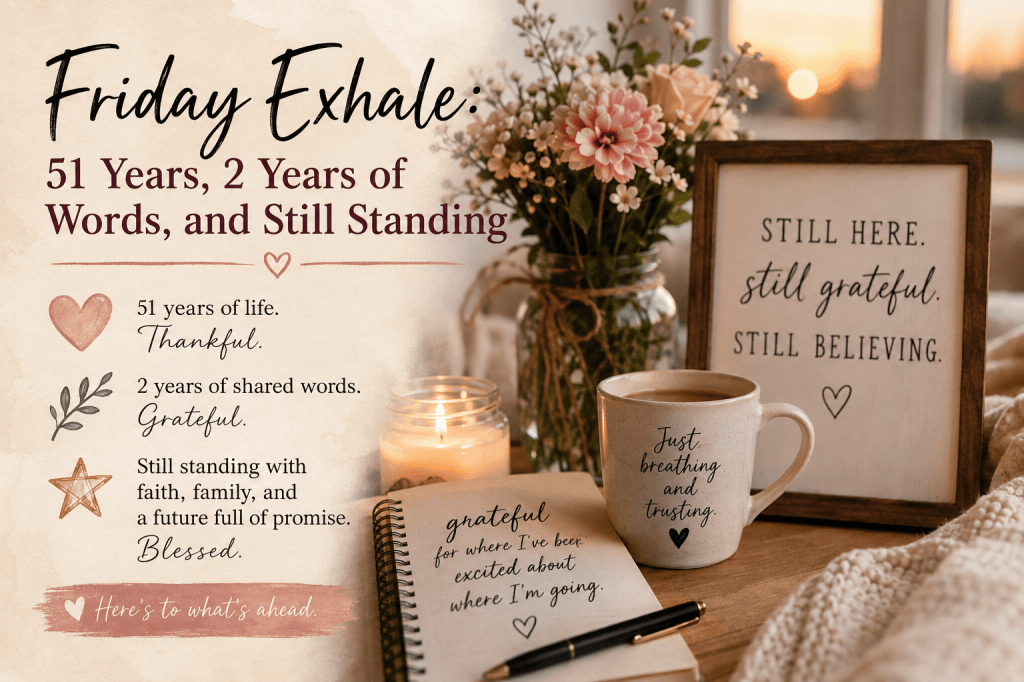
Friday Exhale: 51 Years, 2 Years of Words, and Still Standing


Whew. Take a deep breath with me.
This week brings a quiet moment of reflection as I celebrate my 51st birthday—and mark almost two full years of sharing my heart on this blog. Looking back over where I’ve been and where I am standing today, only one phrase truly fits: I am still here.
Making it to 51 is an incredible, humbling blessing. Life hasn’t been a smooth, polished path; it has been full of real, sharp highs and deep, heavy lows. But sitting here on the other side of those seasons, my heart is overflowing with gratitude.
I look at my life and see a landscape rich with love. I am blessed with a wonderful, supportive husband who stands beside me, incredible children who make me proud every single day, and precious grandchildren who bring endless joy to my world. On top of that, I’m standing on the threshold of exciting new business opportunities, watching hard work turn into real progress.
Through every trial, health scare, and triumph, my family and my faith have been the anchor.
So as this week comes to a close, I’m stepping into the weekend not focused on the weariness of the journey, but on the joy of the destination. Here’s to 51 years of life, two years of shared words, and a future full of promise.
Thankful. Grateful. Blessed.

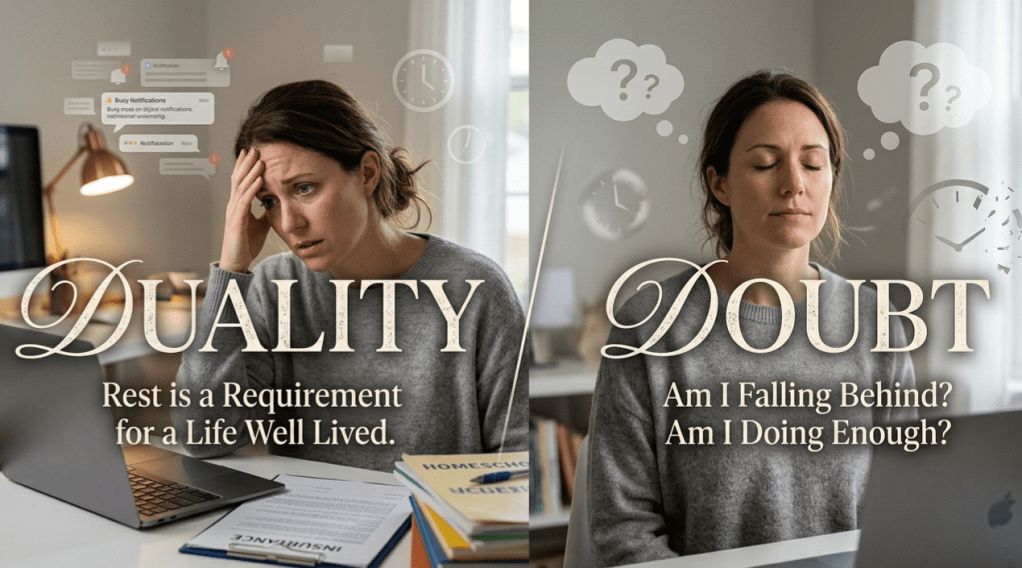
D is for Duality & Doubt: The Monday Morning Backlash


Last week, we waded through the thick of the chaos. We stood face-to-face with the friction of the empty space—that deeply uncomfortable territory where we intentionally stop rushing, clear out the noise, and force ourselves to just sit with the quiet.


If you tried to hold that empty space over the weekend, you know exactly how brutal it is. I personally kept my laptop closed and worked on some things around the house, cleaning, rearranging, and spent some time with my husband. I baked a chocolate cake Sunday afternoon that didn’t quite turn out how I had hoped. But it was a learning experience.


And as the laptop lid lifts open this Monday morning, a brand-new monster is waiting for us.
Welcome to Duality and Doubt.


Once you choose to clear out the chaos, your brain doesn’t just automatically hand you a crown of peace. Instead, a massive internal friction sets in. We find ourselves living a double life inside our own heads.
One version of you—the wise, grounded version—knows deep in your bones that protecting your space is a matter of survival. But the other version, the one conditioned by a world that demands a constant production line, stands over you whispering that your stillness is a failure.


The moment the weekly schedule kicks into gear, these two versions collide, bringing a swift, heavy wave of doubt.
You open the inbox, you look at the tasks ahead—the insurance training and compliance updates, the lesson plans to map out, the physical home to maintain—and the second-guessing begins. Did I lose ground by slowing down? Am I already behind? Did I actually earn the right to breathe?


We are so hooked on constant motion that when we finally create an empty space, we treat it like a crime we have to pay for on Monday morning. We feel the urge to sprint out of the gate at a million miles an hour, frantically overcompensating just to prove we are still worthy.


But true reclamation isn’t about clearing the chaos on Friday just to drown in the doubt on Monday.
The duality we have to master this week is learning how to hold onto our internal stillness while we do the work. It is knowing you can be deeply productive without being frantic.


As you step into the demands of this week, don’t let the Monday morning backlash trick you into running a race you weren’t meant to run. The work will always be there, but your peace belongs to you. Pace yourself today.

Did the doubt hit you the second you opened your screen this morning? How is your brain trying to make you pay for the empty space you kept this weekend?

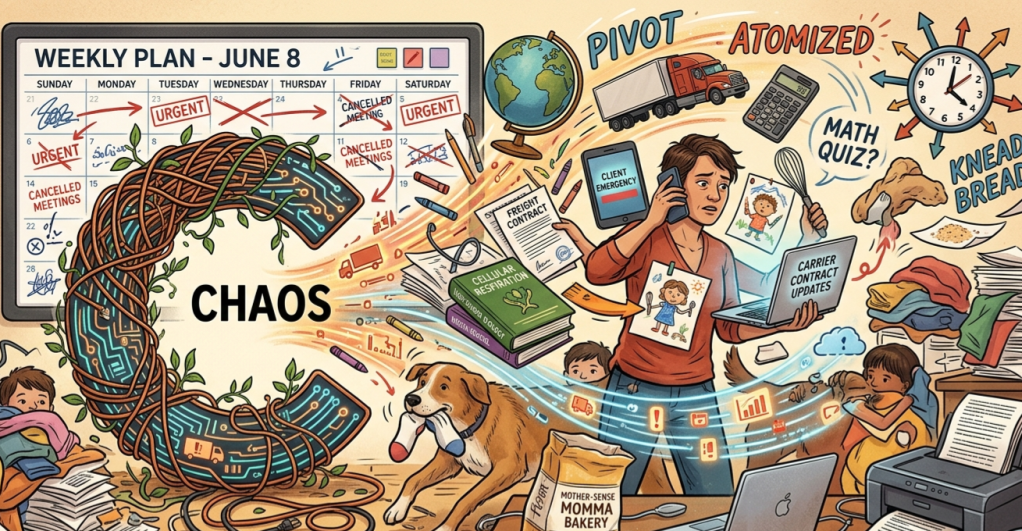
C is for Chaos (and the Logic of Room to Move)

We’ve all done it.
On Sunday night, you sit down with a clean planner, a fresh Sharpie, and a vision. You map out the week with mathematical precision: Monday is carrier underwriting paperwork and high school biology modules; Tuesday is client check-ins and baking routines; Wednesday is a deep dive into catalog management. Every hour has a purpose. Every plate is spinning beautifully.
And then Monday morning happens.
A kid wakes up sick. A critical software system crashes. An unexpected, urgent contract update drops into your inbox, demanding immediate attention. Within two hours, your perfect schedule isn’t just slightly off track—it is completely atomized.
Welcome to the territory of Chaos.
When you are managing an independent business, coordinating a homeschool curriculum, and running a large household under one roof, chaos isn’t a rare visitor. It’s a permanent neighbor.
The real problem isn’t that chaos exists. The problem is how we build our lives to handle it. Most of us build our schedules like a high-stakes puzzle, packing every single piece so tightly against the next that there isn’t a single millimeter of space left over. We think that’s efficiency.
But in the real world, a system with zero space isn’t efficient—it’s fragile. The moment one piece shifts, the whole structure shatters, leaving you standing in the wreckage of your day, wrestling with anxiety, and feeling like you failed.
The Shift: The Logic of Margin
If we want to survive the unpredictable rhythms of a busy life, we have to stop building rigid structures. We need to start building systems with margin.
Think about the way an engineer builds a bridge or a developer writes code for an app. They don’t design it to only handle the absolute best-case scenario. They build in a buffer. They calculate the maximum load and then add extra tolerance for the unexpected heavy winds, the sudden surges, and the system shocks.
They build room to move.
Margin isn’t empty space; it’s functional space. It is the protective boundary that keeps a bad day from turning into a burned-out week.
The Antidote: Creating Your “Chaos Logic”
You can’t control when the unexpected will happen, but you can control how your day reacts to it. Here is how you build chaos logic into your actual, everyday schedule:
The 80% Rule: Never schedule your day to 100% capacity. If you have five usable hours in your work-and-school sandbox, only plan for four. Leave that final hour completely blank on purpose. If the day goes perfectly, congrats—you have an hour to get ahead or rest. If chaos strikes, that hour is your shock absorber.
Define Your “Tier-One” Non-Negotiables: When the day completely blows up, you cannot do it all. Period. You need a mental triage system. Look at your massive list and pick exactly two things that absolutely must happen today to keep the ship moving forward—one for the business, one for the family. Everything else gets automatically bumped to tomorrow without guilt.
Build a “Pivot Protocol”: When the schedule breaks, don’t waste energy frustrating yourself over the broken plan. Accept the pivot immediately. If the internet goes down and you can’t run quotes or submit licensing paperwork, close the screen and pivot entirely to an analog task—do a hands-on history lesson with your son, fold the laundry, or step outside. Work with the friction instead of fighting it.
Chaos wants to convince you that because your plan broke, you are out of control. It wants you to panic, drop your boundaries, and run yourself ragged trying to catch up.
Don’t buy into it.
The strength of your structure isn’t measured by how perfectly you stick to the script; it’s measured by how gracefully you can adapt when life goes off-script. Write your plans in pencil, build a little extra room into your day, and give yourself permission to navigate the chaos one pivot at a time.

Breaking Free from Your Comfort Zone

Where Growth Begins
We all love our comfort zones. They’re warm, familiar, and safe — a space where
routines rule, risks are low, and uncertainty is kept at bay. It’s where we feel in control.
But while this space might feel cozy, it can also become a quiet trap, keeping us stuck in
sameness and stalling our potential.
Growth, learning, and transformation don’t happen in the comfort zone. They begin the
moment we stretch beyond it — when we test our limits, explore the unfamiliar, and
challenge our own self-imposed boundaries.

The Power of the Stretch
Stretching beyond the comfort zone doesn’t mean making reckless decisions or chasing
extremes. It means trying something new, stepping into the unknown even if your voice
shakes, and accepting that discomfort is part of the journey.
Maybe it’s launching that business idea you’ve been sitting on. Or finally signing up for
that fitness class. Maybe it’s starting a creative project, speaking in public, or even just
introducing yourself to someone new. Each step outside the comfort zone is a vote of
confidence in yourself.
The truth is, you can’t grow without a little stretch. That’s how muscles develop, skills
sharpen, and people evolve.

Rethinking Failure: A Learning Opportunity
One of the biggest reasons we cling to the comfort zone is fear — especially the fear of
failure. But what if we started seeing failure for what it really is: a First Attempt In
Learning?

Failure is not a dead-end. It’s feedback. It teaches resilience, refines strategies, and
builds wisdom. Every successful person has failed — not once, but often. The
difference is, they didn’t stop there. They saw failure not as a reflection of their worth,
but as a stepping stone to growth.
Let’s drop the perfectionism. We are often our own harshest critics, expecting ourselves
to get everything right the first time. But perfection is a myth — progress is real. Give
yourself permission to be a beginner. To stumble. To grow messy and real, instead of
polished and safe.

Investing in Yourself Is the Boldest Move You Can Make
Whether you’re dreaming of building a business, learning a new hobby, improving your
health, or expanding your social circle — the first step is the scariest. But it’s also the
most empowering.
Taking a leap of faith isn’t about having zero fear — it’s about moving forward despite
the fear. It’s telling yourself, “I may not have all the answers yet, but I believe I’m worth
the effort.”

A Challenge for You
Today, take one small step outside your comfort zone. It doesn’t have to be dramatic.
Maybe it’s sharing your work online, reaching out to someone you admire, or signing up
for a class. Whatever it is, let it be a declaration: I am willing to grow.
You don’t need to be fearless. You just need to be brave enough to begin.

Remember: Your comfort zone may feel safe, but your potential lives outside of it. Take
the leap. Stretch. Fail. Learn. And most importantly, believe in yourself enough to try.

Redefining Success: Finding Peace in Life’s Surprises

Facing Life’s Uncertainties: Embracing the Next Chapter

At some point in our lives, we all find ourselves in that moment of reflection—the one where we look around and say, “This isn’t what I expected my life to be.” It doesn’t matter what age you are; this feeling can creep up on anyone. Whether you’re 25, 35, 45, or even nearing 60 or 65, you might find yourself questioning the trajectory of your life. Perhaps you’re not where you thought you would be. Maybe your dreams didn’t quite unfold the way you envisioned, or unexpected changes like a career shift, a loss, or a new phase of life are making you ask, “What’s next?”

Life is a journey full of unexpected twists and turns, and as we grow older, we often find ourselves facing moments of doubt and uncertainty. These feelings of questioning and reflection are commonly referred to as an “existential crisis,” and they can come at any age. Whether it’s a mid-life crisis, a career change, the loss of a loved one, or just an overwhelming sense that things aren’t where they should be, this feeling is universal. However, that doesn’t mean it has to be a negative or immobilizing experience. In fact, it can be a powerful opportunity for growth and reinvention.

So, what can you do when you feel like life hasn’t gone as expected? How can you navigate these moments of doubt and find peace and purpose moving forward?

1. Acknowledge Your Feelings

First and foremost, it’s essential to acknowledge that feeling uncertain or disillusioned is normal. There’s no shame in having moments of doubt. If anything, it shows that you are human. These moments are often accompanied by frustration, regret, or even sadness—but these emotions are valid, and you don’t need to suppress them. Allowing yourself to feel them without judgment is the first step to moving forward.

Take time to process these emotions, whether it’s through journaling, talking with a trusted friend, or simply sitting with your thoughts. Reflect on what led you to this point and recognize that it’s okay to have expectations that evolve as life changes.

2. Reframe Your Perspective

One of the most important things you can do when facing an existential crisis is to reframe your perspective. Instead of seeing this period of uncertainty as a failure or missed opportunity, consider it as an invitation to reevaluate your goals, dreams, and values.

The truth is, life rarely unfolds in a straight line. It’s often full of detours, challenges, and moments where we stray from the original path. But these detours can offer new perspectives and experiences that are equally as valuable—if not more so—than the original plan. Look at your life as a work in progress, not a finished product. Each stage and each change has brought you to where you are, and this is part of the adventure.

3. Redefine Success

We often define success based on societal standards: a certain career, financial security, family life, or status. But as you get older, you begin to realize that success is a deeply personal experience. What once seemed like the perfect blueprint for happiness may no longer hold the same allure. This is your opportunity to redefine what success means for you.

Ask yourself: What truly matters to me? Is it happiness? Freedom? Creativity? Fulfillment? Health? Relationships? Redefining success based on your own values rather than external expectations will bring you greater satisfaction and peace of mind as you move forward.

4. Embrace Change and Let Go of the Past

The fear of change often holds us back from taking the necessary steps to move forward. We can get so attached to our past choices, relationships, and circumstances that we resist change, even when it’s for the better. However, change is inevitable, and sometimes it’s necessary for growth.

If you’re stuck in a place of regret or resentment, it’s important to work through these feelings and find a way to let go. Holding on to the past only keeps you anchored in a time that no longer serves you. Forgive yourself for the things you didn’t know or the decisions you wish you could take back. Life is about learning and evolving, and each decision, whether good or bad, has contributed to who you are today.

5. Take Small Steps Toward a New Beginning

When facing an existential crisis, it can feel overwhelming to think about making big changes all at once. Instead of focusing on the end goal, take small steps toward what’s next. Start with something simple, whether it’s taking up a new hobby, learning a new skill, or revisiting an old passion that brought you joy.

You don’t have to make dramatic life-altering decisions overnight. Change is often most sustainable when it’s gradual and intentional. These small steps will help you rediscover what excites and motivates you. Over time, they’ll lead to a greater sense of fulfillment and confidence.

6. Seek Support

You don’t have to go through this alone. Seek out support from friends, family, or a therapist who can help you navigate these difficult emotions. Sometimes, just talking about what you’re feeling can provide clarity and a fresh perspective. If you’re facing significant life changes, such as retirement or loss, talking with others who are going through similar experiences can be incredibly comforting and reassuring.

Remember that no matter how isolated you may feel, you are not alone. Many people have faced moments of uncertainty and emerged stronger, wiser, and more at peace with who they are. Having a support system is key to maintaining your mental and emotional well-being.

7. Embrace the Unknown

One of the most liberating things you can do when faced with an existential crisis is to embrace the unknown. Life is unpredictable, and while we may want to have everything mapped out, the beauty of life often lies in its uncertainty. It’s okay not to have all the answers.

By embracing uncertainty, you open yourself up to new possibilities and opportunities. You might not know exactly what the future holds, but that’s where the adventure lies. By remaining open to change, you allow space for creativity, growth, and the unexpected joys that life can bring.

8. Focus on What You Can Control

During times of uncertainty, it’s easy to become overwhelmed by the things outside of your control. However, focusing on what you can control—your mindset, your actions, and your attitude—can empower you to take charge of your future. When life feels chaotic, focusing on small, actionable steps can provide a sense of stability and purpose.

Take care of your mental and physical health, nurture your relationships, and pursue goals that are meaningful to you. The more you focus on the areas where you have agency, the more empowered you’ll feel to navigate whatever life throws your way.

Conclusion: Live and Light

Life will never unfold exactly as we expect it, and that’s okay. What matters most is how we respond to the curveballs life throws at us. If you find yourself feeling stuck or questioning where you are in life, remember that it’s not the end of the road—it’s the beginning of something new.

Take a deep breath, acknowledge your feelings, and know that the next chapter is yours to write. Embrace change, redefine your success, seek support, and take small steps toward the future you desire. Life is about growth, reinvention, and embracing whatever comes next.

Sign off with a sense of lightness. You are not alone in this journey, and every step forward—no matter how small—is progress. Keep living, keep evolving, and keep finding the joy in the unexpected.