Sometimes a song doesn’t arrive as a fully formed idea. It slips in sideways. A single line. A feeling you can’t shake. A truth that feels a little too loud to say out loud.
For me, one of those moments came wrapped in a lyric that hit harder than I expected:
“If I’m too much, go find less.”
I can’t take credit for that line — it comes from Elyse Meyers — but the second I heard it, it felt like someone had reached into my chest and put words to something I’d been carrying for a long time.
Even though I’d had similar thoughts, I’d never said them that clean, that sharp. That honest.
And that’s what stuck with me.
Because it didn’t come from confidence. Not at first. It came from that raw, uncomfortable place where you realize how often you’ve been shrinking yourself to fit into spaces that were never built for you.
I’ve spent years being a lot of things to a lot of people. Mom. Wife. Student. Teacher. The reliable one. The strong one. The one who keeps it all together. And somewhere in all of that, there were pieces of me I kept sanding down. Softer. Quieter. Easier to hold.
More “acceptable.”
But that line? That line was the snap.
It was the moment the narrative shifted from “Am I too much?” to “Why am I apologizing for being enough?”
That’s where the song started to take shape.
—
The First Spark
When I wrote that lyric, I wasn’t thinking about structure or genre or where it would fit. I was thinking about every time I bit my tongue. Every time I softened a truth. Every time I made myself smaller so someone else could stay comfortable.
That one line carried all of that.
So instead of building a song around an idea, I built the idea around that line.
What does it look like to stop apologizing?
What does it sound like to own your edges instead of hiding them?
What does it feel like to finally say, this is who I am — take it or leave it?
—
Letting It Get a Little Wild
At first, the song leaned reflective. Almost restrained. But the more I sat with it, the more I realized that wasn’t honest.
Because the truth isn’t quiet.
The truth, for me, was a little feral.
It had teeth.
It laughed too loud. It made questionable choices. It lit the match instead of walking away from the fire.
So I leaned into that.
I let the verses get bolder. Messier. More unapologetic. I stopped trying to make the narrator likable and started making her real.
That’s when the song found its voice.
—
Writing for Me, Not for Approval
There’s a version of songwriting where you’re always thinking about the listener. What will they like? What will land? What will sell?
And then there’s the version where you tell the truth first.
This song demanded the second version.
It wasn’t about being polished. It wasn’t about being palatable. It was about being honest in a way that felt a little dangerous.
Because if I’m being real, the line “If I’m too much, go find less” isn’t just a lyric.
It’s a boundary.
It’s a declaration.
It’s a refusal to keep editing myself down to a version that’s easier for someone else to hold.
—
The Shape It Took
By the time the song settled into itself, it wasn’t soft anymore.
It had grit. A little swagger. A little chaos.
It became a kind of anthem for that version of me that doesn’t ask permission anymore.
The one who knows exactly who she is — even when that’s inconvenient.
Especially then.
—
Why It Matters
I think we all have a version of ourselves we’ve been told is “too much.”
Too loud. Too emotional. Too driven. Too complicated. Too honest.
And we learn, over time, how to file those edges down.
But here’s the thing I’ve learned through writing this song:
The parts of you they call “too much” are usually the parts that are most you.
And maybe the goal isn’t to fix that.
Maybe the goal is to finally stand in it.
Fully.
Unapologetically.
And if that’s too much for someone?
They’re free to go find less.
—
That’s where this song came from.
Not from perfection.
From truth.
And honestly? That’s the only place worth writing from anymore.
—
The Line That Lit It (Full Circle)
And it still takes me back to that line I didn’t write, but absolutely claimed in spirit — the one from Elyse Meyers that put words to what I’d been circling for years.
Because sometimes the most powerful thing isn’t inventing the truth.
It’s recognizing it when you hear it.
And having the guts to build something honest in response.
—
Lyrics Excerpt
Verse I bent myself to fit the frame Cut my edges, dulled my flame Smiled nice and played it safe Just to keep the peace in place
Pre-Chorus But something in me finally broke Somewhere between the hush and choke
Chorus If I’m too much, go find less I’m done drowning in second-guess I won’t shrink to ease your mind Take it or leave it, this is mine Strike the match, watch it burn I ain’t got a damn thing left to learn If I’m fire you can’t confess If I’m too much, go find less
Bridge A little wild, a little free A little more of who I’m meant to be No more trimming down the truth No more asking for your proof
—
That’s the song that came out of it.
Not borrowed. Not copied. But sparked — by a line that told the truth so clearly, I couldn’t ignore it.
Tag: wife

Why Emotional Labor Deserves Recognition
The Cost of Being Unpaid
I often feel invisible. Not unseen in a dramatic way—but quietly, persistently taken for granted.
My empathy, my sympathy, my knowledge, and the countless things I offer other human beings move through the world without acknowledgment. I do not get paid to cook nourishing meals. I do not earn a wage for listening while someone vents, or for offering advice, or for helping untangle problems that aren’t mine. There is no paycheck for being available, for showing up emotionally, for holding space.
And yet, these things take time. They take energy. They take experience.
I have knowledge. I have lived enough life to understand nuance, to adapt, to learn quickly, to respond with compassion and clarity. I share all of it freely—especially with family. I give because I care, because connection matters to me, because helping feels natural. But because there is no monetary value attached to my time, no salary or hourly rate, it often feels as though my worth is somehow less.
Less than my sisters.
Less than anyone who earns money doing things.
I know—logically—that my skills have value. I know that emotional intelligence, adaptability, and lived experience are not insignificant. But where do they fit on a wage scale? What number do you assign to being the person others rely on? Why does value seem to exist only when it can be measured in dollars?
If I stopped doing all the things I normally do—if I were no longer available, no longer the listener, the helper, the cook, the steady presence—what then? Would the absence finally make the value visible? Or would it simply be filled by someone else, still unpaid, still unacknowledged?
Americans are relentlessly committed to monetizing every moment. A hobby can’t just be enjoyable—it has to become a side hustle. Creativity must be productive. Passion must be profitable. But a hobby stops being fun the moment it becomes a have to instead of a want to. When joy is turned into obligation, something essential is lost.
So I keep circling back to the same painful question:
If I am not valuable because I do not earn money… then what does that say about all the work that keeps people going but never appears on a balance sheet?
Maybe the problem isn’t my worth.
Maybe the problem is a system that only recognizes value when it can be billed, sold, or taxed.
And maybe being unpaid does not mean being unworthy—no matter how often the world makes it feel that way.
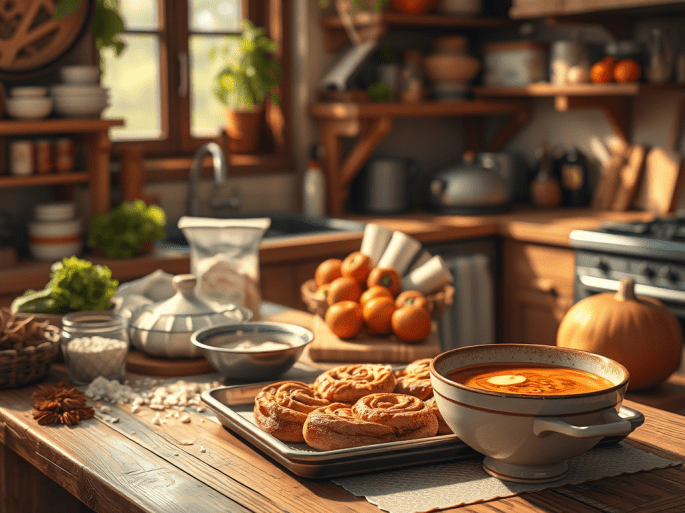
Therapeutic Cooking: Finding Peace in Recipes
Finding Peace in the Kitchen: Cooking My Way Through the Chaos
Lately, I’ve been spending a lot of time in the kitchen — testing recipes, adjusting ingredients, and finding creative ways to use what I already have on hand. It’s not just about food; it’s about coping. It’s how I manage the discombobulation of my feelings, the uncertainty of the world, and the heaviness that sometimes tries to creep in. Cooking keeps my hands busy, my mind focused, and my heart grounded.
My kids are loving this little culinary journey — they’ve become my official taste testers. Not every recipe is a winner, but that’s part of the fun. My cinnamon rolls, for example, turned out tough and not fluffy at all. Instead of tossing them, I chopped them up, added a custard base, and turned them into a cinnamon roll French toast bake. It was a hit! Proof that even “failed” recipes can have delicious second lives.
I’ve been challenging myself to waste less and create more. Leftover taco meat, beans, Spanish rice, and corn turned into a comforting fall soup — some went straight into the freezer for another day. A close-dated can of fruit cocktail became the unexpected star of my “sweet heat salsa” when I mixed it with some red pepper flakes. I poured it over a pork roast, served it with mashed potatoes, and let me tell you — it was so good. Simple, cozy, belly-filling goodness.
Cooking every day — baking bread, making tortillas, mixing my own seasonings — has become more than a necessity. It’s a form of therapy. It helps me stay present and productive while I navigate this time of year, which has been difficult for me for a number of years. Recently, I restocked my pantry: flour, sugar, baking powder, cocoa, beans, potatoes, meats… all the staples that keep a kitchen humming. It gave me a strange sense of comfort and accomplishment — a reminder that even when life feels uncertain, there’s something deeply grounding about being able to nourish my family.
Sometimes, I think about my mom, Granny, Aunt Mertie, my former mother-in-law, and my Daddy. They all enjoyed my cooking, especially when my experiments turned out well. I think they’d be proud of me now — keeping their traditions alive while adding my own twist.
This — the mixing, the kneading, the simmering — this is how I cope. It’s how I manage the overwhelm, the grief, the unknown. It’s creative, it’s practical, and it fills both the stomach and the soul.
So if you’re feeling weighed down by the world or by your own thoughts, maybe try stirring something up in your kitchen. You might just find a bit of peace in the process, too.
Love and light, y’all.
And remember — you matter.

Embracing Imperfection: Finding Grace in Struggle
I’m Letting You in on a Little Secret…
I’m going to let you guys in on a little secret: I do not have all of my ducks in a row!
Shocking, right? I know a little bit (or maybe a whole lot) about a great deal of things — cooking, baking, sautéing, homemaking, making money stretch — you name it. I’ve built real skills over the years, and I take pride in them. But even with all that knowledge, I still have those days. The ones that make me want to crawl back into bed and pull the covers over my head. The days that drag on so long and hard that I catch myself wishing the time away.
Yes, I know how to make money work for me, but I’ll be honest — once the needs are covered, I still struggle. Do I treat myself to something nice? Save it for later? Spend it on my kids? The internal debate is real.
I live with PTSD and anxiety. I get “blue” days — not what I’d call depression, but heavy enough that I feel it in my bones. I’ve seen true depression up close — in my children, in my ex-husband, in others I love — and it has taught me a lot about compassion, patience, and grace.
Some days, I’m full of energy and optimism, ready to take on the world. And other days… I’m lucky if I can get supper cooked. And that’s okay. I’ve learned that even with all my knowledge — about money, about mental health, about coping — some days just aren’t it.
On those days, I have to remind myself: give yourself grace. Say, “Enough. Be still. Rest.” You don’t have to do it all — especially today.
But here’s the tricky part: rest can easily turn into avoidance if we’re not careful. It’s important to recognize what’s going on and act accordingly. Listen to your instincts. Listen to your body. Rest when you need to — but also, when it’s time, get up and move.
Take the shower. Bake the bread. Step outside and touch grass.
We’re all learning in this life — every second, every day. We just have to keep showing up.
And if you ever feel like you fell short or owe someone an apology — do it, mean it, and move on. Know better, do better. Every. Single. Day.
Love and light,
💛 Julie

The Power of Empathy: Finding Hope Amidst Suffering
Is it just me?
Cautiously Optimistic: Navigating the Weight of Others’ Pain
I’ve often described myself as a cautiously optimistic person. It’s a way of being that helps me face the challenges of life with hope but without completely abandoning my awareness of how fragile things can be. I try to hold on to the belief that things will get better, that there is light at the end of every dark tunnel. Yet, beneath this cautious optimism is something much deeper—an empathy that can feel all-consuming. I feel everything, and when I say everything, I mean everything.
It’s as if my heart is finely attuned to the pain of the world. When I see someone struggling, whether it’s a close friend or a stranger, I feel their burden. I feel their sadness, their frustration, their fear. It’s hard to explain to those who don’t share this experience, but it’s almost as if I can physically feel their emotions in my own body. And with this heightened sense of empathy comes a natural desire to help. If I’m in, I’m all in. When someone I care about is hurting, I will do everything within my power to ease their pain. But here’s where the challenge lies: No matter how much I want to help, no matter how deeply I feel their suffering, I can’t fix everything.
And that’s the part that has become so difficult. Everywhere I go, I see people struggling. Whether it’s a friend facing a personal crisis, a family member dealing with loss, or a stranger encountering hardships I’ll never fully understand, it feels like there is a constant presence of pain in the world. It’s overwhelming at times. And as much as I want to be there for everyone, as much as I want to ease their suffering and show them that they are not alone, I feel a sense of helplessness that gnaws at me.
I think the hardest part is that the more I care, the more I absorb. I can’t turn off my empathy. When someone is hurting, I can’t just ignore it or pretend it doesn’t affect me. So, I carry these burdens with me. I hold space for others’ pain even when I have nothing left to give. This emotional weight becomes part of my daily existence, and sometimes, it feels like it’s a battle to simply get through the day without being overwhelmed.
Coping has become a process—a continuous, daily, and sometimes hourly, practice. I’ve learned to breathe through moments of heaviness, to step back and remind myself that it’s okay not to have all the answers. I’ve had to accept that my capacity to help is limited, that sometimes, the best thing I can offer is simply my presence, my listening ear, and my unwavering support. But that doesn’t always feel like enough. I want to do more—to take away the pain, to find a solution, to make it all better. The frustration of knowing that I can’t is, at times, unbearable.
But as I reflect on these feelings, I realize that my cautious optimism isn’t about ignoring the pain or pretending that everything is fine. It’s about holding space for hope, even in the face of suffering. It’s about recognizing that while I may not have the power to fix everything, I do have the ability to show up, to care, and to be a source of light in the lives of others.
The truth is, I may never be able to ease all of the burdens that I see around me, and that’s something I have to come to terms with. But I also believe that even the smallest acts of kindness, empathy, and support can make a difference. They may not erase the pain, but they can help carry it for a little while. And maybe, just maybe, that’s enough.
So, I’ll continue to navigate the world with this cautious optimism—holding space for the pain I encounter, but also holding space for the hope that one day, things will get better. I’ll keep doing what I can, even when it feels like it’s not enough, because I know that the journey of healing is a shared one. We may not always have the power to solve each other’s problems, but we can always choose to walk alongside each other, offering empathy, understanding, and love. And in the end, maybe that’s the most important thing we can do.

